Question
Study the passage given below carefully and answer the questions that follow:
The collapse of Communism was followed in most of these countries by a painful process of transition from an authoritarian socialist system to a democratic capitalist system. Privatisation of state assets and corporate ownership Patterns were to be immediately brought in.
  1. Why was the process of transition been described as painful?
  2. Which political system existed before the transition and which system replaced it, if any?
  3. What does privatisation imply?

Answer

  1. The collapse of communism was followed in most of the countries by a painful process from an authoritarian socialist system to a democratic system.
  2. From Authoritarian to democratic capitalist system.
  3. Privatisation imply that state having assets and ownership pattern. And disinvestment all these for the betterment of the country. Whereas as the govt. remained little right and gone the lion share to private sector players.

Need a full question paper?

Generate a complete, print-ready paper with questions like this in minutes — across 16+ boards, with answer keys.

Start Generating Free

Similar questions

How did the European countries resolve their post-Second World War problem? Briefly outline the attempts that led to the formation of the European Union.
The most serious challenge before the states is pursuing economic development without causing further damage to the global environment. How could we achieve this? Explain with a few examples.
Read the following passage carefully and answer the questions that follow:
In the event of a nuclear war, both sides will be so badly harmed that it will be impossible to declare one side or the other as the winner, even if one of them tries to attack and disable the nuclear weapons of its rival, the other would still be left with enough nuclear weapons to inflict unacceptable destruction. Both sides have the capacity to retaliate against an attack and to cause so much destruction that neither can afford to initiate war. Thus, the cold war– inspite of being an intense form of rivalry between great powers– remained a ‘cold’ and not hot or shooting war. The deterrence relationship prevents war but not the rivalry between powers.
  1. Why did intense rivalry between the super powers remain a cold war only?
  2. Why can’t a nuclear war between the two nuclear powers be decisive?
  3. Explain the logic of ‘deterrence’.
Read this passage and answer the questions below:
“Broadly, non-alignment means not tying yourself off with military blocs….It means trying to view things, as far as possible, not from the military point of view, though that has to come in sometimes, but independently, and trying to maintain friendly relations with all countries.” — JAWAHARLAL NEHRU
  1. Why does Nehru want to keep off military blocs?
  2. Do you think that the Indo-Soviet friendship treaty violated the principle of non-alignment? Give reasons for your answer.
  3. If there were no military blocs, do you think non-alignment would have been unnecessary?
List any four demands of the Narmada Bachao Andolan.
Assess any three basis on which globalisation is being resisted in India.
What is meant by Security? Mention any four components of Indian security strategy.
Many people think that a two-party system is required for successful democracy. Drawing from India’s experience of last twenty years, write an essay on what advantages the present party system in India has.
Compare the aims and achievements of the First and the Second Five Year Plans to conclude which of the two was a turning point in India’s development.
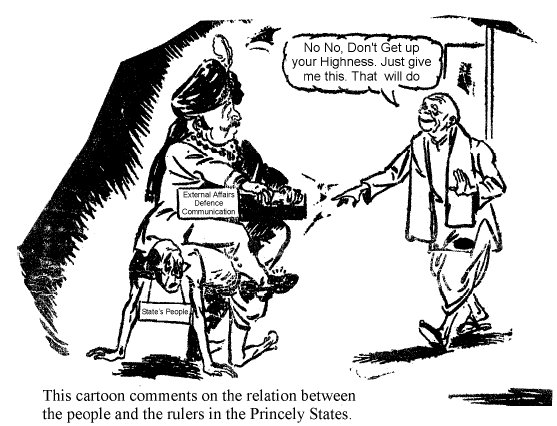
Study the following cartoon carefully and answer the questions that follow:
  1. Identify and name the leader shown on the right in the cartoon.
  2. What type of relationship does the cartoon indicate between the people and the ruler?
  3. In your opinion, how successful was the approach adopted by the leader on the right to solve the issue of Princely States?