MCQ
Substance on the choroid is
  • A
    Japan black
  • Nigrim pigment
  • C
    Carbon black
  • D
    Platinum black

Answer

Correct option: B.
Nigrim pigment

Need a full question paper?

Generate a complete, print-ready paper with questions like this in minutes — across 16+ boards, with answer keys.
Start Generating Free

Similar questions

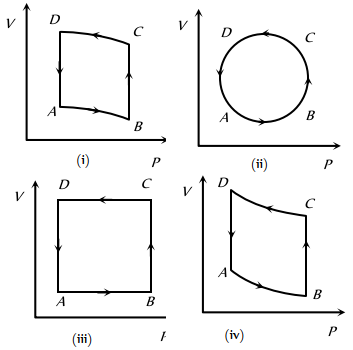
In the diagrams (i) to (iv) of variation of volume with changing pressure is shown. A gas is taken along the path $A B C D$. The change in internal energy of the gas will be
Image
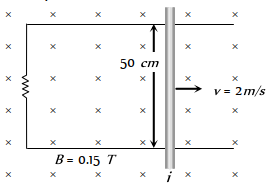
As shown in the figure a metal rod makes contact and complete the circuit. The circuit is perpendicular to the magnetic field with $B=0.15$ tesla If the resistance is $3 \Omega$, force needed to move the rod as indicated with a constant speed of $2 \mathrm{~m} / \mathrm{sec}$ is
Image
A cell of emf $90\,V$ is connected across series combination of two resistors each of $100\,\Omega$ resistance. A voltmeter of resistance $400\,\Omega$ is used to measure the potential difference across each resistor. The reading of the voltmeter will be $.........\,V$
The reactance of a $25 \mu F$ capacitor at the ac frequency of $4000\ Hz$ is
A thin metal disc of radius $r$ floats on water surface and bends the surface downwards along the perimeter making an angle $\theta$ with vertical edge of the disc. If the disc displaces a weight of water $W$ and surface tension of water is $T$, then the weight of metal disc is
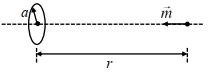
A special metal $S$ conducts electricity without any resistance. A closed wire loop, made of $S$, does not allow any change in flux through itself by inducing a suitable current to generate a compensating flux. The induced current in the loop cannot decay due to its zero resistance. This current gives rise to a magnetic moment which in turn repels the source of magnetic field or flux. Consider such a loop, of radius $a$, with its center at the origin. A magnetic dipole of moment $m$ is brought along the axis of this loop from infinity to a point at distance $r \gg a)$ from the center of the loop with its north pole always facing the loop, as shown in the figure below.

The magnitude of magnetic field of a dipole $m$, at a point on its axis at distance $r$, is $\frac{\mu_0}{2 \pi} \frac{m}{r^3}$, where $\mu_0$ is the permeability of free space. The magnitude of the force between two magnetic dipoles with moments, $m_1$ and $m_2$, separated by a distance $r$ on the common axis, with their north poles facing each other, is $\frac{k m_1 m_2}{r^4}$, where $k$ is a constant of appropriate dimensions. The direction of this force is along the line joining the two dipoles.

($1$) When the dipole $m$ is placed at a distance $r$ from the center of the loop (as shown in the figure), the current induced in the loop will be proportional to

$(A)$ $\frac{m}{r^3}$ $(B)$ $\frac{m^2}{r^2}$ $(C)$ $\frac{m}{r^2}$ $(D)$ $\frac{m^2}{r}$

($2$) The work done in bringing the dipole from infinity to a distance $r$ from the center of the loop by the given process is proportional to

$(A)$ $\frac{m}{r^5}$ $(B)$ $\frac{m^2}{r^5}$ $(C)$ $\frac{m^2}{r^6}$ $(D)$ $\frac{m^2}{r^7}$

Give the answer or qution ($1$) and ($2$)
Cathode rays consist of
Consider a binary star system consisting of two stars of masses $M_1$ and $M_2$ separated by a distance of $30 AU$ with a period of revolution equal to $30$ years. If one of the two stars is $5$ times farther from the centre of mass than the other. The masses of the two stars in terms of solar masses are
The amount of substance liberated on electrodes during electrolysis when 1 coulomb of electricity is passed, is
Boiling water is changing into steam. At this stage the specific heat of water is