Question
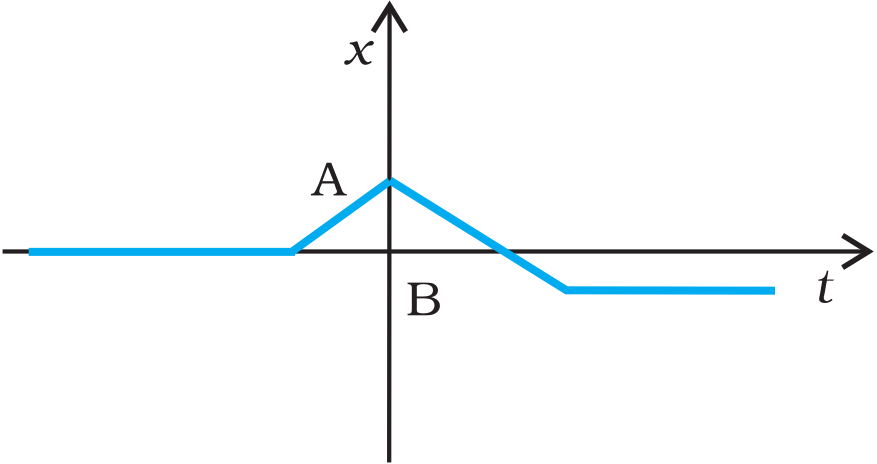
Suggest a suitable physical situation for of the following graphs.

Answer

The given x-t graph shows that initially a body was at rest. Then, its velocity increases with time and attains an instantaneous constant value. The velocity then reduces to zero with an increase in time. Then, its velocity increases with time in the opposite direction and acquires a constant value. A similar physical situation arises when a football (initially kept at rest) is kicked and gets rebound from a rigid wall so that its speed gets reduced. Then, it passes from the player who has kicked it and ultimately gets stopped after sometime.
Need a full question paper?

Generate a complete, print-ready paper with questions like this in minutes — across 16+ boards, with answer keys.

Start Generating Free

Similar questions

Establish the kinematic equation v2 - u2 = 2as from velocity-time graph for a uniformly accelerated motion.
Air $(\gamma=1.4)$ is pumped at 2atm pressure in a motor tyre at 20°C. If the tyre suddenly bursts, what would be the temperature of the air coming out of the tyre? Neglect any mixing with the atmospheric air.
Discuss the variation of 'g' with depth. What happens to 'g' at the centre of earth?
Equal torqueses are applied on a cylinder and a sphere. Both have same mass and radius. The cylinder rotates about its axis and the sphere rotates about one of its diameters. Which will acquire greater speed? Explain why.
A satellite is revolving around the earth, close to the surface of earth with a kinetic energy E. How much kinetic energy should be given to it so that it escapes from the surface of earth?
Find the temperature at which the speed of sound in oxygen will be the same as that in nitrogen at 20°C. Given that molar masses of oxygen and nitrogen are 32 and 28 respectively. Both gases are assumed to be ideal.
A man of mass 70kg stands on a weighing scale in a lift which is moving.
What would be the reading if the lift mechanism failed and it hurtled down freely under gravity?
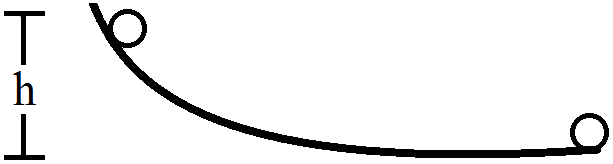
A small spherical ball is released from a point at a height h on a rough track shown in figure. Assuming that it does not slip anywhere, find its linear speed when it rolls on the horizontal part of the track.

What is the angular velocity at any point on the equator so that the body feels weightlessness?
Find the angular velocity of a body rotating with an acceleration of 2 rev/s2 as it completes the 5th revolution after the start.