Question
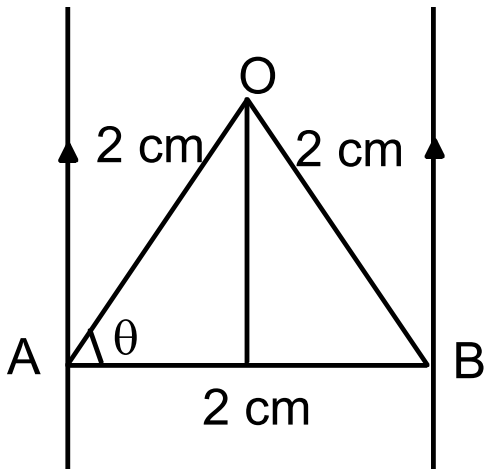
Two parallel wires carry equal currents of 10A along the same direction and are separated by a distance of 2.0cm. Find the magnetic field at a point which is 2.0cm away from each of these wires
Answer


$\cos\theta=\frac{1}{2},$

$\theta=60^\circ\ \&\ \angle\text{AOB}=60^\circ$

$\text{B}=\frac{\mu_0\text{I}}{2\pi\text{r}}=\frac{10^{-7}\times2\times10}{2\times10^{-2}}=10^{-4}\text{T}$

So net is $[(10^{-4})^2]+(10^{-4})^2+2(10^{-8})\cos60^\circ]^\frac{1}{2}$

$=10^{-4}\Big[1+1+2\times\frac{1}{2}\Big]^\frac{1}{2}$

$=10^{-4}\times\sqrt3\text{T}$

$=1.732\times10^{-4}\text{T}$

Need a full question paper?

Generate a complete, print-ready paper with questions like this in minutes — across 16+ boards, with answer keys.

Start Generating Free

Similar questions

When you lift a box from the floor and put it on an almirah the potential energy of the box increases, but there is no change in its kinetic energy. Is it a violation of conservation of energy?
Explain Ohm's law. State factors on which the resistance of any conductor depends. Define specific resistance and state its relation with the conductivity.
A rod is inserted as the core in the current-carrying solenoid of the previous problem.
  1. What is the magnetic intensity H at the centre?
  2. If the magnetization I of the core is found to be 0.12Nm, find the susceptibility of the material of the rod.
  3. Is the material paramagnetic, diamagnetic or ferromagnetic?
  1. Consider an arbitrary electrostatic field configuration. A small test charge is placed at a null point (i.e., where E = 0) of the configuration. Show that the equilibrium of the test charge is necessarily unstable.
  2. Verify this result for the simple configuration of two charges of the same magnitude and sign placed a certain distance apart.
The centre of mass is defined as $\overrightarrow{\text{R}}=\frac{1}{\text{M}}\sum\limits_\text{i}\text{m}_\text{i}\overrightarrow{\text{r}_{\text{i}}}.$ Suppose we define "centre of charge" as $\overrightarrow{\text{R}}_\text{c}=\frac{1}{\text{Q}}\sum\limits_\text{i}\text{q}_\text{i}\overrightarrow{\text{r}_{\text{i}}}$ where qi represents the ith charge placed at $\overrightarrow{\text{r}_\text{i}}$ and Q is the total charge of the system.
  1. Can the centre of charge of a two-charge system be outside the line segment joining the charges?
  2. If all the charges of a system are in X-Y plane, is it necessary that the centre of charge be in X-Y plane?
  3. If all the charges of a system lie in a cube, is it necessary that the centre of charge be in the cube?
A double convex lens, made from a material of refractive index $\mu_1,$ is immersed in a liquid of refractive index $\mu_2$ where $\mu_1>\mu_2.$ What change, if any, would occur in the nature of the lens?
A point object is placed on the principal axis of a convex lens (f = 15cm) at a distance of 30cm from it. A glass plate $(\mu=1.50)$ of thickness 1cm is placed on the other side of the lens perpendicular to the axis. Locate the image of the point object.
Suppose the platform with the kid in the previous problem is rotating in anticlockwise direction at an angular speed $\omega.$ The kid starts walking along the rim with a speed v relative to the platform also in the anticlockwise direction. Find the new angular speed of the platform.

A parallel plate capacitor, each with plate area A and separation d, is charged to a potential difference V. The battery used to charge it is then disconnected. A dielectric slab of thickness d and dielectric constant K is now placed between the plates. What change, if any, will take place in.

  1.  Charge on the plates.
  2. Electric field intensity between the plates.
  3. Capacitance of the capacitor.
In Young’s double slit experiment, monochromatic light of wavelength 630 nm illuminates the pair of slits and produces an interference pattern in which two consecutive bright fringes are separated by 8.1 mm. Another source of monochromatic light produces the interference pattern in which the two consecutive bright fringes are separated by 7.2 mm. Find the wavelength of light from the second source.
What is the effect on the interference fringes if the monochromatic source is replaced by a source of white light?