Question
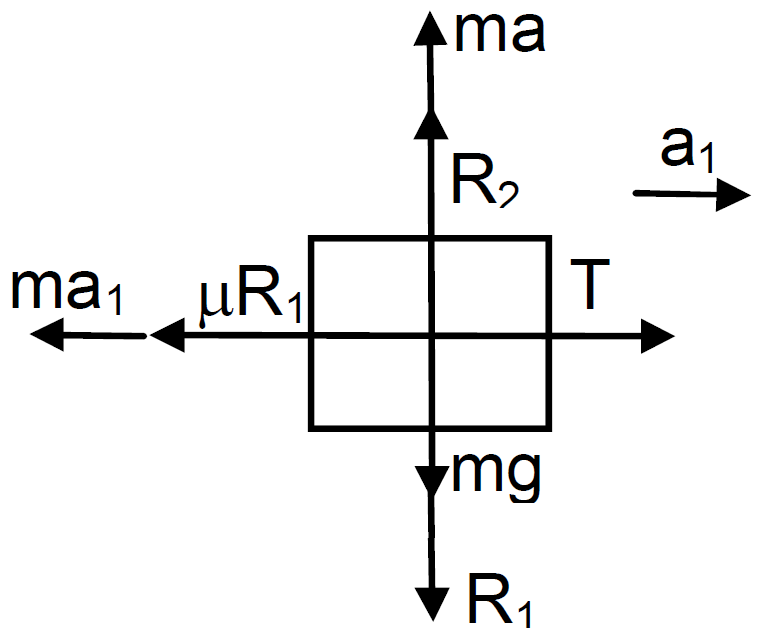
Suppose the entire system of the previous question is kept inside an elevator which is coming down with an acceleration $a < g.$ Repeat parts $(a)$ and $(b).$
Answer


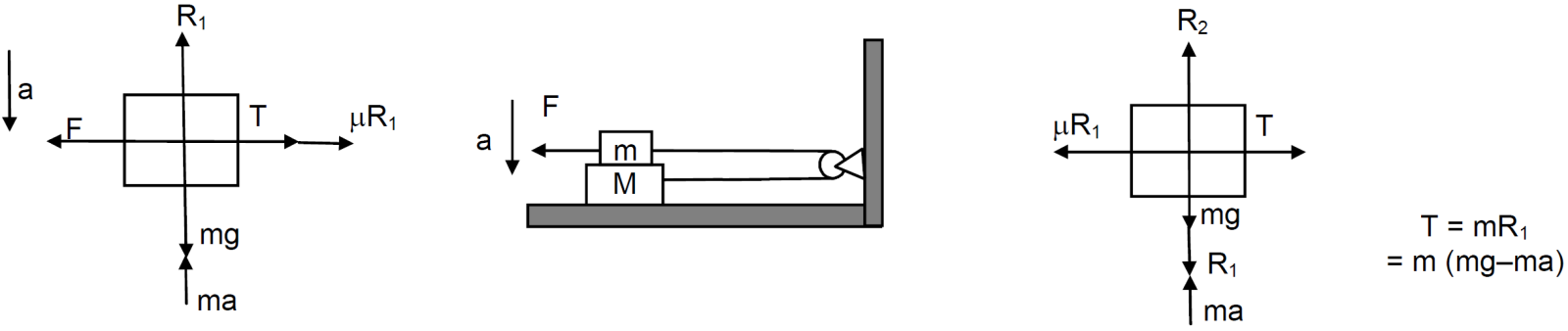
$\text{R}_1+\text{ma}-\text{mg}=0$
$\Rightarrow\text{R}_1=\text{m(g}-\text{a) = mg}-\text{ma} \ ...(\text{i})$
$\text{T}-\mu\text{R}_1=0\Rightarrow\text{T = m(mg}-\text{ma}) \ ...(\text{ii})$
Again, $\text{F}-\text{T}-\mu\text{R}_1=0$
$\Rightarrow\text{F}-\{\mu(\text{mg}-\text{ma})\}-\text{u}(\text{mg}-\text{ma})=0$
$\Rightarrow\text{F}-\mu\text{mg}+\mu\text{ma}-\mu\text{mg}+\mu\text{ma}=0$
$\Rightarrow\text{F}=2\mu\text{mg}-2\mu\text{ma}$
$\Rightarrow\text{F}=2\mu\text{m(g}-\text{a})$
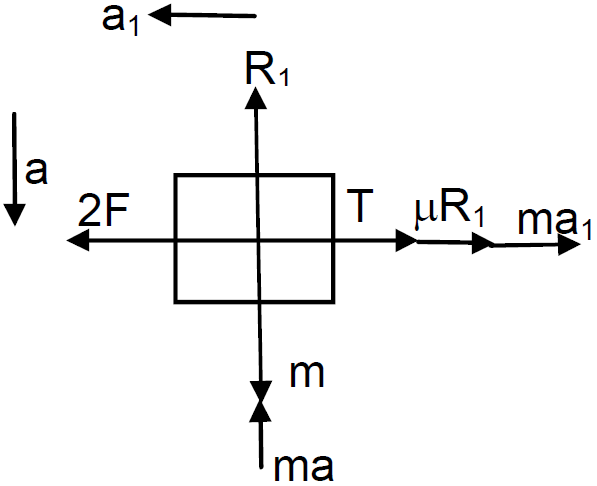
  1. Acceleration of the block be $a_1$

$\text{R}_1=\text{mg}-\text{ma} \ ...(\text{i})$
$2\text{F}-\text{T}-\mu\text{R}_1-\text{ma}_1=0$
$\Rightarrow2\text{F}-\text{t}-\mu\text{mg}+\mu\text{a}-\text{ma}_1=0 \ ...(\text{ii})$

$\text{T}-\mu\text{R}_1-\text{Ma}_1=0$
$\Rightarrow\text{T}=\mu\text{R}_1+\text{Ma}_1$
$\Rightarrow\text{T}=\mu(\text{mg}-\text{ma})+\text{Ma}_1$
$\Rightarrow\text{T}=\mu\text{mg}-\mu\text{ma + Ma}_1$
Subtracting values of $F\  T, $ we get
$2(2\mu\text{m(g}-\text{a}))-2(\mu\text{mg}-\mu\text{ma}+\text{Ma}_1)$
$-\mu\text{mg}+\mu\text{ma}-\mu\text{a}_1=0$
$\Rightarrow4\mu\text{mg}-4\mu\text{ma}-2\mu\text{mg}+2\mu\text{ma = ma}_1+\text{Ma}_1$
$\Rightarrow\text{a}_1=\frac{2\mu\text{m(g}-\text{a})}{\text{M + m}}$
Both blocks move with this acceleration but in opposite directions.

Need a full question paper?

Generate a complete, print-ready paper with questions like this in minutes — across 16+ boards, with answer keys.
Start Generating Free

Similar questions

What is interference of light? Write two essential conditions for sustained interference pattern to be produced on the screen. Draw a graph showing the variation of intensity versus the position on the screen in Young's experiment when (a) both the slits are opened and (b) one of the slit is closed. What is the effect on the interference pattern in Young's double-slit experiment when: 32. 33.
i. Screen is moved closer to the plane of slits?
ii. Separation between two slits is increased. Explain.
A compound microscope consists of an objective of focal length $1\ cm$ and an eyepiece of focal length $5\ cm$. An object is placed at a distance of $0.5\ cm$ from the objective. What should be the separation between the lenses so that the microscope projects an inverted real image of the object on a screen $30\ cm$ behind the eyepiece?
Two charges $q_1$ and $q_2$ are placed at $(0, 0, d)$ and $(0, 0, -d)$ respectively. Find locus of points where the potential a zero.
Suppose the loop in Exercise $6.4$ is stationary but the current feeding the electromagnet that produces the magnetic field is gradually reduced so that the field decreases from its initial value of $0.3T$ at the rate of $0.02T s^{–1}$. If the cut is joined and the loop has a resistance of $1.6\Omega ,$ how much power is dissipated by the loop as heat? What is the source of this power?
A free $^{238}U$ nucleus kept in a train emits an alpha particle. When the train is stationary, $a$ nucleus decays and $a$ passenger measures that the separation between the alpha particle and the recoiling nucleus becomes $x$ at time $t$ after the decay. If the decay takes place while the train is moving at a uniform velocity $v,$ the distance between the alpha particle and the recoiling nucleus at $a$ time $t$ after the decay as measured by the passenger is:
The resistance of the rheostat shown in the figure. is $30\Omega.$ Neglecting the meter resistance, find the minimum and maximum currents through the ammeter as the rheostat is varied.
When the sun is directly overhead, the surface of the earth receives $1.4 \times 10^3 W m^{-2}$ of sunlight. Assume that the light is monochromatic with average wavelength $500nm$ and that no light is absorbed in between the sun and the earth's surface. The distance between the sun and the earth is $1.5 \times 10^{11}m.$
  1. Calculate the number of photons falling per second on each square metre of earth's surface directly below the sun.
  2. How many photons are there in each cubic metre near the earth's surface at any instant?
  3. How many photons does the sun emit per second?
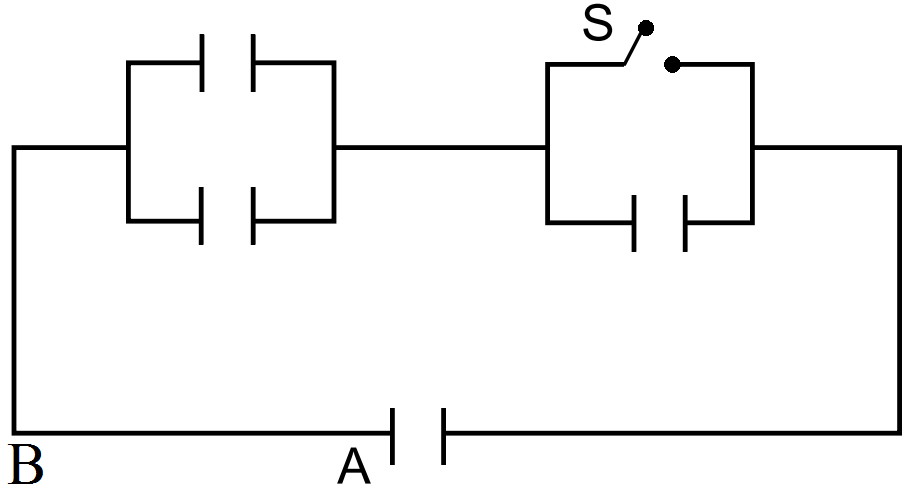
Each capacitor shown in figure has a capacitance of $5.0\mu\text{F}.$ The emf of the battery is $50V.$ How much charge will flow through $AB$ if the switch $S$ is closed?
A normal eye has retina 2cm behind the eye-lens. What is the power of the eye-lens when the eye is
  1. Fully relaxed,
  2. Most strained?
Draw a simple circuit of a $CE$ transistor amplifier. Explain its working. Show that the voltage gain $, A_V,$ of the amplifier is given by $\text{A}_{V} = - \frac{\beta_{ac}\text{R}_{L}}{\text{r}_{i}},$ where $ \beta_{ac}$ is the current gain $, R_L$ is the load resistance and $r_i$ is the input resistance of the transistor. What is the significance of the negative sign in the expression for the voltage gain?