Question
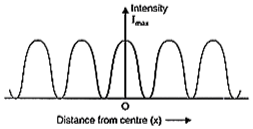
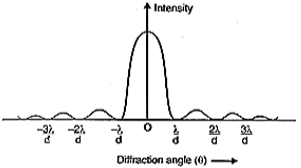
What is interference of light? Write two essential conditions for sustained interference pattern to be produced on the screen. Draw a graph showing the variation of intensity versus the position on the screen in Young's experiment when (a) both the slits are opened and (b) one of the slit is closed. What is the effect on the interference pattern in Young's double-slit experiment when: 32. 33.
i. Screen is moved closer to the plane of slits?
ii. Separation between two slits is increased. Explain.
Answer

Interference of light: Phenomenon of redistribution of light energy in a medium on account of superposition of light waves from two coherent sources is called interference of light.
Conditions for sustained interference: The two essential conditions of sustained interference are as follows:
i. The two sources of light should emit light continuously.
ii. The light waves should be of same wavelength (Monochromatic).
(a) When both the slits are open, we get an interference pattern on the screen. Then the following intensity distribution curve is obtained.
Image
(b) When one of the slits is closed, diffraction pattern is obtained on the screen. The following intensity curve is obtained. 
Image

Also we know that, Fringe width, $\beta=\frac{D \lambda}{d}$, therefore i. The distance D decreases, the fringe width $\beta$ also decreases if screen is moved closer to the plane of the slits.
ii. Fringe width $\beta$ decreases if separation d between two slits is increased.

Need a full question paper?

Generate a complete, print-ready paper with questions like this in minutes — across 16+ boards, with answer keys.

Start Generating Free

Similar questions

A gas is enclosed in a cylindrical can fitted with a piston. The walls of the can and the piston are adiabatic. The initial pressure, volume and temperature of the gas are $100kPa, 400\ cm^3$ and $300K,$ respectively. The ratio of the specific heat capacities of the gas is $\frac{\text{C}_\text{P}}{\text{C}_\text{V}}=1.5.$ Find the pressure and the temperature of the gas if it is,
  1. Suddenly compressed.
  2. Slowly compressed to $100\ cm^3.$
A mica strip and a polysterene strip are fitted on the two slits of a double slit apparatus. The thickness of the strips is $0.50\ mm$ and the separation between the slits is $0.12\ cm$. The refractive index of mica and polysterene are $1.58$ and $1.55$ respectively for the light of wavelength $590\ nm$ which is used in the experiment. The interference is observed on a screen a distance one meter away.
  1. What would be the fringe-width?
  2. At what distance from the centre will the first maximum be located?
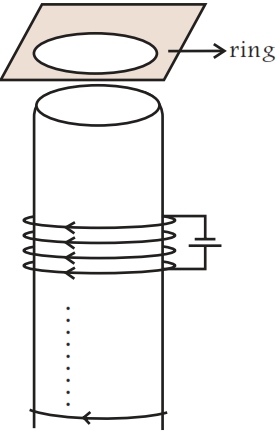
Consider a metal ring kept on top of a fixed solenoid (say on a carboard) (Fig). The centre of the ring coincides with the axis of the solenoid. If the current is suddenly switched on, the metal ring jumps up. Explain.
Suppose India had a target of producing by $2020 AD, 200,000 MW$ of electric power, ten percent of which was to be obtained from nuclear power plants. Suppose we are given that, on an average, the efficiency of utilization $($i.e. conversion to electric energy$)$ of thermal energy produced in a reactor was $25\%$. How much amount of fissionable uranium would our country need per year by $2020$ ? Take the heat energy per fission of $^{235}\text{U}$ to be about $200MeV$.
A square loop of side $12\ cm$ with its sides parallel to $X$ and $Y$ axes is moved with a velocity of $8\ cms^{–1}$ in the positive $x-$ direction in an environment containing a magnetic field in the positive $z-$ direction. The field is neither uniform in space nor constant in time. It has a gradient of $10^{–3}T \ cm^{–1}$ along the negative $x-$ direction $($that is it increases by $10^{–3}T \ cm^{–1}$ as one moves in the negative $x-$ direction$),$ and it is decreasing in time at the rate of $10 ^{–3}T s^{–1}$. Determine the direction and magnitude of the induced current in the loop if its resistance is $4.50 m\Omega$ .
Explain the experiments of Faraday and Henry for explaining and describing the phenomenon of electromagnetic induction.
Write the properties of diamagnetic, paramagnetic and ferromagnetic materials.
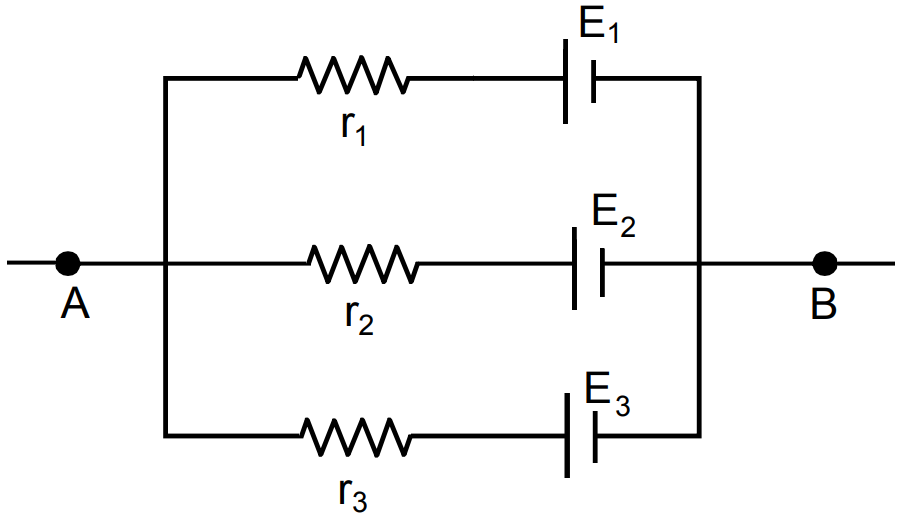
In the circuit shown in the figure. $\epsilon_1=3\text{V},\epsilon_2=2\text{V},\epsilon_3=1\text{V}$ and $\text{r}_1=\text{r}_2=\text{r}_3=1\Omega.$ Find the potential difference between the points A and B and the current through each branch.
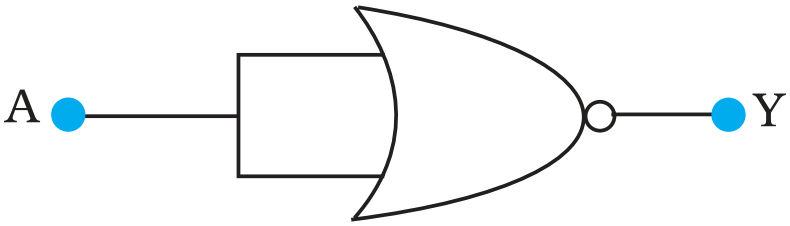
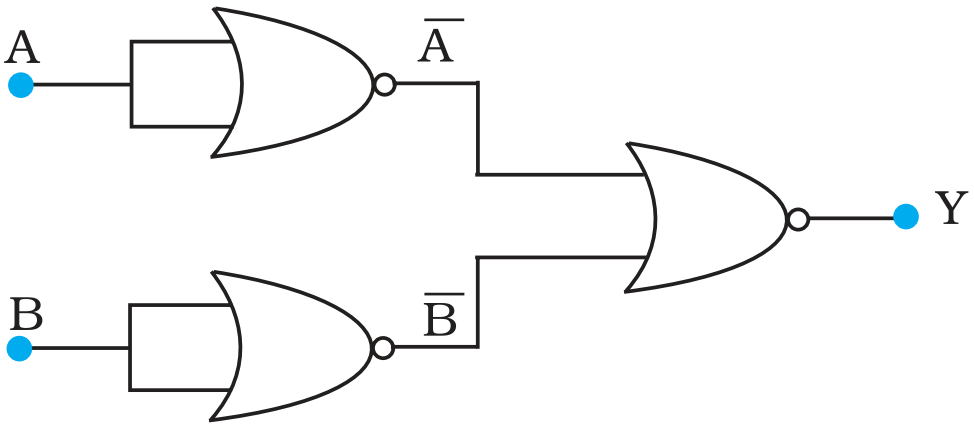
Write the truth table for the circuits given in Fig. 14.48 consisting of NOR gates only. Identify the logic operations (OR, AND, NOT) performed by the two circuits.
  1.  
  1.  
We have stimulated emission and spontaneous emission. Do we also have stimulated absorption and spontaneous absorption?