Question
Suppose the loop in Exercise 6.4 is stationary but the current feeding the electromagnet that produces the magnetic field is gradually reduced so that the field decreases from its initial value of 0.3T at the rate of 0.02T s–1. If the cut is joined and the loop has a resistance of 1.6Ω, how much power is dissipated by the loop as heat? What is the source of this power?
Answer

Sides of the rectangular loop are 8cm and 2cm.
Hence, area of the rectangular wire loop,
A = length × width
= 8 × 2 = 16cm2
= 16 × 10-4m2
Initial value of the magnetic field, Br = 0.3T
Rate of decrease of the magnetic field, $\frac{\text{dB}}{\text{dt}}=0.02\text{T/s}$
Emf developed in the loop is given as:
$\text{e}=\frac{\text{d}\phi}{\text{dt}}$
$\text{d}\phi=$ Change in flux through the loop area
= AB
$\therefore\ \text{e}=\frac{\text{d(AB)}}{\text{dt}}=\frac{\text{AdB}}{\text{dt}}$
= 16 × 10-4 × 0.02 = 0.32 $\therefore$ 10-4V
Resistance of the loop, $\text{R}=1.6\Omega$
The current induced in the loop is given as:
$\text{i}=\frac{\text{r}}{\text{R}}$
$=\frac{0.32\times10^{-4}}{1.6}=2\times10^{-5}\text{A}$
Power dissipated in the loop in the form of heat is given as:
P = i2R
= (2 × 10⁻⁵)2 × 1.6
= 6.4 × 10-10 W
The source of this heat loss is an external agent, which is responsible for changing the magnetic field with time.

Need a full question paper?

Generate a complete, print-ready paper with questions like this in minutes — across 16+ boards, with answer keys.

Start Generating Free

Similar questions

Derive an expression for magnetic field intensity due to a magnetic dipole at a point lies on its equatorial line.
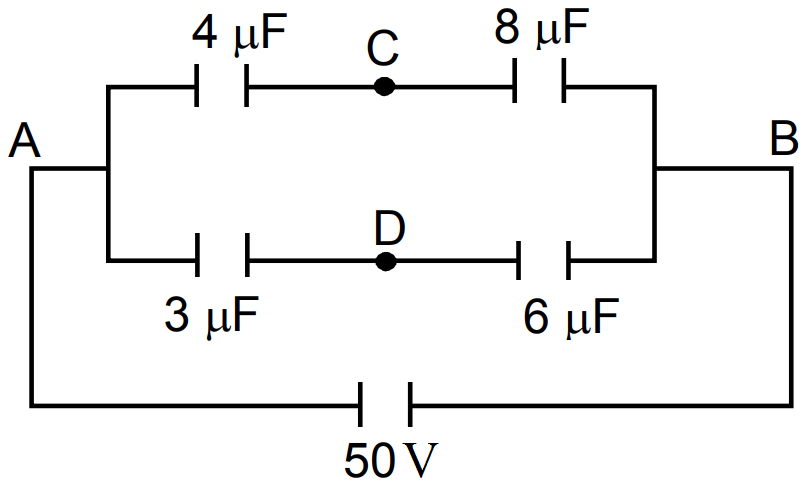
Take the potential of the point B in figure to be zero:
  1. Find the potentials at the points C and D.
  2. If a capacitor is connected between C and D, what charge will appear on this capacitor?

A pin of length 2.0cm lies along the principal axis of a converging lens, the centre being at a distance of 11cm from the lens. The focal length of the lens is 6cm. Find the size of the image.
Find the minimum colatitude which can directly receive a signal from a geostationary satellite.
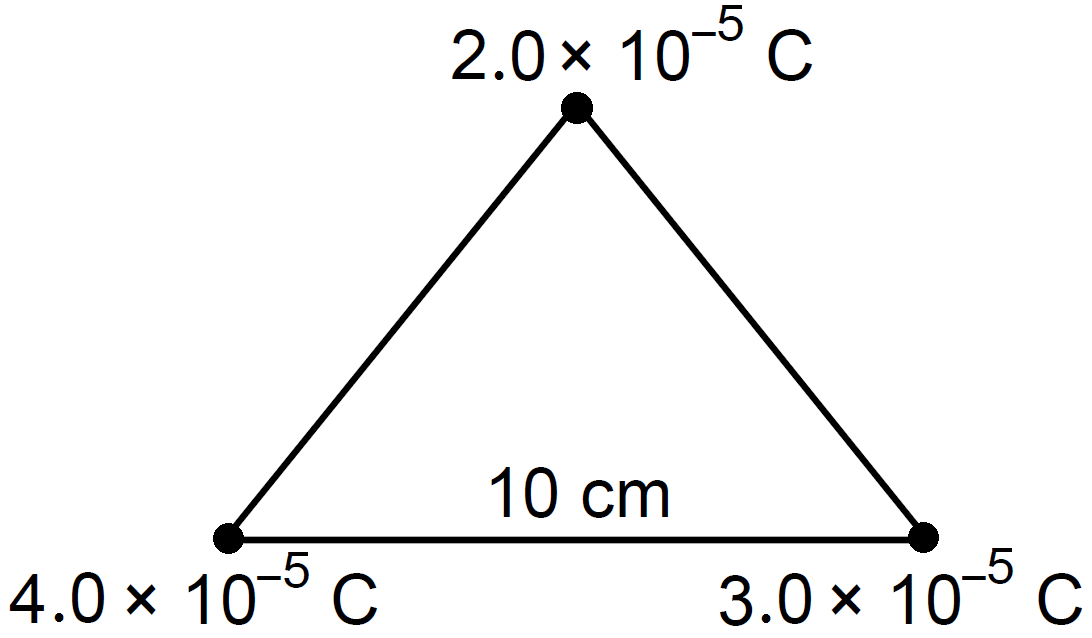
How much work has to be done in assembling three charged particles at the vertices of an equilateral triangle as shown in figure?

A charge of $1\mu\text{C}$ is given to one plate of a parallel-plate capacitor of capacitance $0.1\mu\text{F}$ and a charge of $2\mu\text{C}$ is given to the other plate. Find the potential difference developed between the plates.
What is meant by the transverse nature of electromagnetic waves? Draw a diagram showing the propagation of an electromagnetic wave along X-direction, indicating clearly the directions of oscillating electric and magnetic fields associated with it.
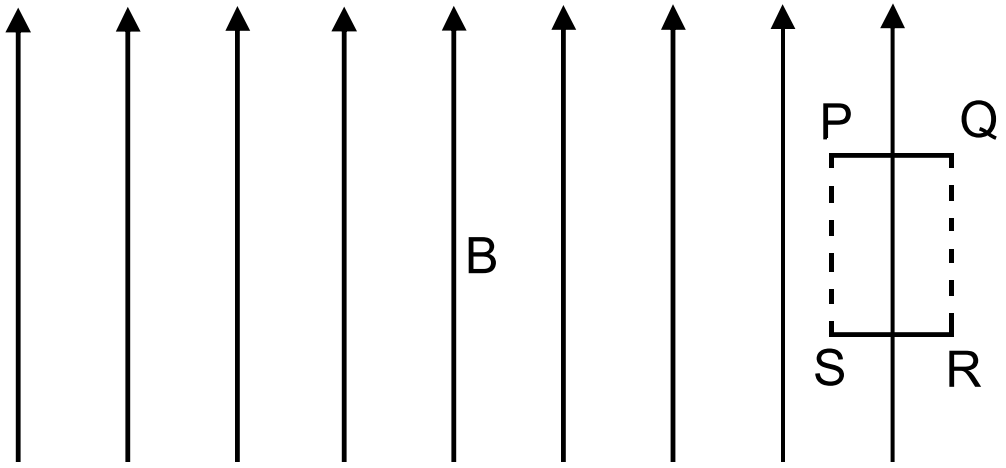
Sometimes we show an idealised magnetic field which is uniform in a given region and falls to zero abruptly. One such field is represented in figure. Using Ampere's law over the path PQRS, show that such a field is not possible.

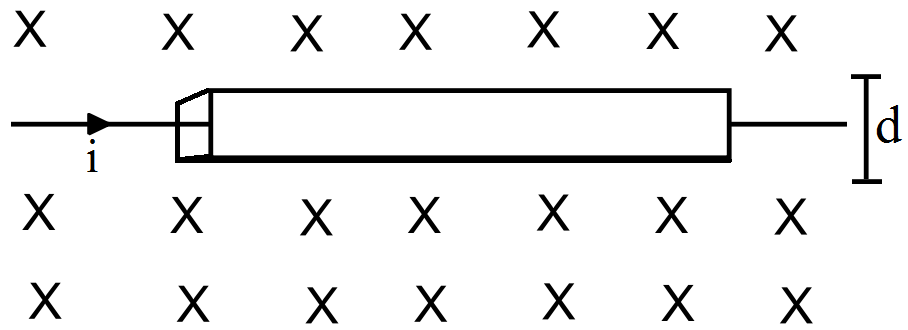
A current i is passed through a silver strip of width d and area of cross-section A. The number of free electrons per unit volume is n.
  1. Find the drift velocity v of the electrons.
  2. If a magnetic field B exists in the region, as shown in the figure, what is the average magnetic force on the free electrons?
  3. Due to the magnetic force, the free electrons get accumulated on one side of the conductor along its length. This produces a transverse electric field in the conductor, which opposes the magnetic force on the electrons. Find the magnitude of the electric field which will stop further accumulation of electrons.
  4. What will be the potential difference developed across the width of the conductor due to the electron-accumulation? The appearance of a transverse emf, when a current-carrying wire is placed in a magnetic field, is called Hall effect.

Four equal charges 2.0 × 10-6C each are fixed at the four corners of a square of side 5cm. Find the Coulomb force experienced by one of the charges due to the rest three.