Question
Suppose white light falls on a double slit but one slit is covered by a violet filter (allowing $\lambda=400\text{nm}$). Describe the nature of the fringe pattern observed.

Answer

The violet filter will allow only violet light to pass through it. Now, if the double slit experiment is performed with the white light and violet light, the fringe pattern will not be the same as obtained by just using white light as the source. To have interference pattern, the light waves entering from the slits should be monochromatic. So, in this case, the violet light will superimpose with only violet light (of wavelength 400nm) in such a way that the bright bands will be of violet colour and the minima will be completely dark.

Need a full question paper?

Generate a complete, print-ready paper with questions like this in minutes — across 16+ boards, with answer keys.
Start Generating Free

Similar questions

Write Einstein's photoelectric equation. State clearly how this equation is obtained using the photon picture of electromagnetic radiation.
Write the three salient features observed in photoelectric effect which can be explained using this equation.
A particle moves in a circle of diameter $1.0\ cm$ under the action of a magnetic field of $0.40T.$ An electric field of $200 Vm^{-1}$ makes the path straight. Find the charge/ mass ratio of the particle.
A resistance R and a capacitor C are connected in series to a source $\text{V}=\text{V}_0\sin\omega\text{t}.$
Find:
  1. The peak value of the voltage across the (i) resistance and (ii) capacitor.
  2. The phase difference between the applied voltage and current. Which of them is ahead?
Does a nucleus lose mass when it suffers gamma decay?
  1. Define self inductance. Write its $S.I. $units.
  2. Derive an expression for self inductance of a long, solenoid of length $l, $cross sectional area $A$ having $N$ number of turns.
A 5.0 diopter lens forms a virtual image which is 4 times the object placed perpendicularly on the principal axis of the lens. Find the distance of the object from the lens.
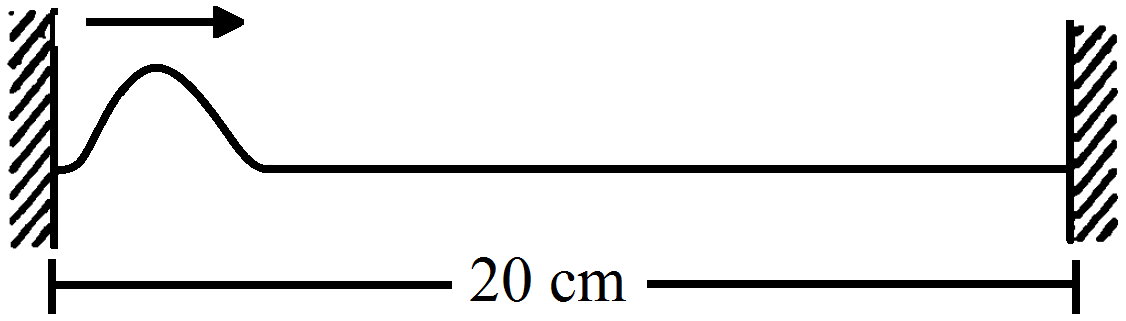
A string of length 20cm and linear mass density 0.40g/cm is fixed at both ends and is kept under a tension of 16N. A wave pulse is produced at t = 0 near an end as shown in figure, which travels towards the other end.
  1. When will the string have the shape shown in the figureagain
  2. Sketch the shape of the string at a time half of that found in part (a).
Answer the following questions:
  1. In a double slit experiment using light of wavelength $600 \ nm$, the angular width of the fringe formed on a distant screen is $0.1^o$. Find the spacing between the two slits.
  2. Light of wavelength $5000 \mathring A$ . Propagating in air gets partly reflected from the surface of water. How will the wavelengths and frequencies of the reflected and refracted light be affected?
In a soccer practice session the football is kept at the centre of the field $40$ yards from the $10ft$ high goalposts. A goal is attempted by kicking the football at a speed of $64ft/s$ at an angle of $45^\circ$ to the horizontal. Will the ball reach the goal post?
  1. Obtain the expression for the cyclotron frequency.
  2. A deuteron and a proton are accelerated by the cyclotron. Can both be accelerated with the same oscillator frequency? Give reason to justify your answer.