The acceleration of a particle performing S.H.M. is at a distance of $3\; cm$ from the mean position is $ 12\,cm/sec^2 $. Its time period is ..... $\sec$
Easy
Download our app for free and get started
(d)$T = 2\pi \sqrt {\frac{{{\rm{Displacement}}}}{{{\rm{Acceleration}}}}} $
$ = 2\pi \sqrt {\frac{3}{{12}}} = \pi = 3.14\;\sec $

Download our appand get started for free
Experience the future of education. Simply download our apps or reach out to us for more information. Let's shape the future of learning together!No signup needed.*
Similar Questions
- 1View SolutionResonance is an example of
- 2A heavy small-sized sphere is suspended by a string of length $l$. The sphere rotates uniformly in a horizontal circle with the string making an angle $\theta $ with the vertical. Then the time period of this conical pendulum isView Solution
- 3A weightless spring which has a force constant oscillates with frequency $n$ when a mass $m$ is suspended from it. The spring is cut into two equal halves and a mass $2m $ is suspended from it. The frequency of oscillation will now becomeView Solution
- 4View SolutionIn the adjacent figure, if the incline plane is smooth and the springs are identical, then the period of oscillation of this body is
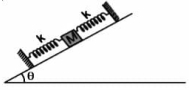
- 5Two particles executing $S.H.M.$ of same frequency, meet at $x=+A / 2$, while moving in opposite directions. Phase difference between the particles is .........View Solution
- 6For any $S.H.M.$, amplitude is $6\, cm$. If instantaneous potential energy is half the total energy then distance of particle from its mean position is .... $cm$View Solution
- 7If the length of simple pendulum is increased by $300\%$, then the time period will be increased by ..... $\%$View Solution
- 8A spring is stretched by $5 \,\mathrm{~cm}$ by a force $10 \,\mathrm{~N}$. The time period of the oscillations when a mass of $2 \,\mathrm{~kg}$ is suspended by it is :(in $s$)View Solution
- 9Which graph represents the difference between total energy and potential energy of a particle executing $SHM$ Vs it's distance from mean position?View Solution
- 10A particle executing simple harmonic motion has an amplitude of $6\, cm$. Its acceleration at a distance of $2 \,cm$ from the mean position is $8\,cm/{s^2}$. The maximum speed of the particle is ... $ cm/s$View Solution