For any $S.H.M.$, amplitude is $6\, cm$. If instantaneous potential energy is half the total energy then distance of particle from its mean position is .... $cm$
Easy


Download our appand get started for free
Experience the future of education. Simply download our apps or reach out to us for more information. Let's shape the future of learning together!No signup needed.*
Similar Questions
- 1The $ P.E.$ of a particle executing $SHM$ at a distance $x$ from its equilibrium position isView Solution
- 2The displacement of a particle along the $x-$ axis is given by $x=asin^2$$\omega t$ . The motion of the particle corresponds toView Solution
- 3View SolutionSelect wrong statement about simple,harmonic motion
- 4View SolutionWhat effect occurs on the frequency of a pendulum if it is taken from the earth surface to deep into a mine
- 5The equation of an $S.H.M.$ with amplitude $A$ and angular frequency $\omega$ in which all the distances are measured from one extreme position and time is taken to be zero at the other extreme position is ...View Solution
- 6The length of a simple pendulum is increased by $1\%$. Its time period willView Solution
- 7The distance covered by a particle undergoing $SHM$ in one time period is (amplitude $= A$)View Solution
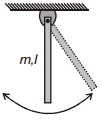
- 8A uniform rod of mass $m$ and length $I$ is suspended about its end, Time period of small angular oscillations is ..........View Solution
- 9View SolutionIn a simple harmonic motion, when the displacement is one-half the amplitude, what fraction of the total energy is kinetic?
- 10A body of mass $m $ is attached to the lower end of a spring whose upper end is fixed. The spring has negligible mass. When the mass $m$ is slightly pulled down and released , it oscillates with a time period of $3\,s$ . When the mass $m$ is increased by $1\,kg$ , the time period of oscillations becomes $5\,s$ . The value of $m$ in $kg$ isView Solution