The amplitude and the periodic time of a $S.H.M.$ are $ 5\,cm$ and $6\,sec$ respectively. At a distance of $2.5\,cm$ away from the mean position, the phase will be
Medium
Download our app for free and get started
The equation of motion is given as $y=5 \sin \frac{2 \pi t}{6}$
Here, $y=2.5 cm$
$\therefore 2.5=5 \sin \frac{2 \pi t}{6}$
$\Rightarrow \frac{\pi}{6}=\frac{2 \pi t}{6} \Rightarrow t=\frac{1}{2} s$
$\therefore$ The phase $=\frac{2 \pi t}{6}=\frac{2 \pi}{6} \times \frac{1}{2}=\frac{\pi}{6}$

Download our appand get started for free
Experience the future of education. Simply download our apps or reach out to us for more information. Let's shape the future of learning together!No signup needed.*
Similar Questions
- 1The displacement of simple harmonic oscillator after $3$ seconds starting from its mean position is equal to half of its amplitude. The time period of harmonic motion is $\dots \; s$View Solution
- 2If displacement $x$ and velocity $v$ are related as $4v^2 = 16\, -\, x^2$ in a $SHM$ . Then time period of given $SHM$ is (consider $SI\,units$ )View Solution
- 3View SolutionWhich of the diagrams shown in figure represents variation of total mechanical energy of a pendulum oscillating in water as function of time ?
- 4A vibratory motion is represented by $x = 2\,A\,\cos \,\omega t + A\,\cos \,\left( {\omega t + \frac{\pi }{2}} \right) + A\,\cos \,\left( {\omega t + \pi } \right) + \frac{A}{2}\,\cos \,\left( {\omega t + \frac{{3\pi }}{2}} \right)$ The resultant amplitude of motion isView Solution
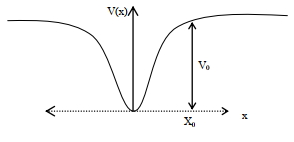
- 5When a particle of mass $m$ moves on the $x$-axis in a potential of the form $V(x)=\mathrm{kx}^2$ it performs simple harmonic motion. The corresponding time period is proportional to $\sqrt{\frac{\mathrm{m}}{\mathrm{k}}}$, as can be seen easily using dimensional analysis. However, the motion of a particle can be periodic even when its potential energy increases on both sides of $\mathrm{x}=0$ in a way different from $\mathrm{kx}^2$ and its total energy is such that the particle does not escape to infinity. Consider a particle of mass $\mathrm{m}$ moving on the $x$-axis. Its potential energy is $V(x)=\alpha x^4(\alpha>0)$ for $|x|$ near the origin and becomes a constant equal to $\mathrm{V}_0$ for $|x| \geq X_0$ (see figure). $Image$View Solution
$1.$ If the total energy of the particle is $E$, it will perform periodic motion only if
$(A)$ $E$ $<0$ $(B)$ $E$ $>0$ $(C)$ $\mathrm{V}_0 > \mathrm{E}>0$ $(D)$ $E > V_0$
$2.$ For periodic motion of small amplitude $\mathrm{A}$, the time period $\mathrm{T}$ of this particle is proportional to
$(A)$ $\mathrm{A} \sqrt{\frac{\mathrm{m}}{\alpha}}$ $(B)$ $\frac{1}{\mathrm{~A}} \sqrt{\frac{\mathrm{m}}{\alpha}}$ $(C)$ $\mathrm{A} \sqrt{\frac{\alpha}{\mathrm{m}}}$ $(D)$ $\mathrm{A} \sqrt{\frac{\alpha}{\mathrm{m}}}$
$3.$ The acceleration of this particle for $|\mathrm{x}|>\mathrm{X}_0$ is
$(A)$ proportional to $\mathrm{V}_0$
$(B)$ proportional to $\frac{\mathrm{V}_0}{\mathrm{mX}_0}$
$(C)$ proportional to $\sqrt{\frac{\mathrm{V}_0}{\mathrm{mX}_0}}$
$(D)$ zero
Give the answer qustion $1,2$ and $3.$
- 6Which of the following expressions corresponds to simple harmonic motion along a straight line, where $x$ is the displacement and $a, b, c$ are positive constants?View Solution
- 7A mass m oscillates with simple harmonic motion with frequency $f = \frac{\omega }{{2\pi }}$ and amplitude A on a spring with constant $K$ , thereforeView Solution
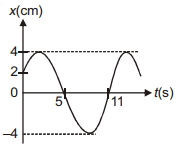
- 8Figure shows the position-time graph of an object in $S.H.M.$ The correct equation representing this motion is ..........View Solution
- 9A pendulum suspended from the ceiling of a train oscillates with a time period $2\,second$, when the train is accelerating at $10\,ms^{-2}$. What will be its time period when the train retards at $10\,ms^{-2}$ ? ..... $\sec$View Solution
- 10The force-deformation equation for a nonlinear spring fixed at one end is $F =4x^{1/ 2}$ , where $F$ is the force (expressed in newtons) applied at the other end and $x$ is the deformation expressed in metersView Solution