If displacement $x$ and velocity $v$ are related as $4v^2 = 16\, -\, x^2$ in a $SHM$ . Then time period of given $SHM$ is (consider $SI\,units$ )
Medium


Download our appand get started for free
Experience the future of education. Simply download our apps or reach out to us for more information. Let's shape the future of learning together!No signup needed.*
Similar Questions
- 1A $100 \,g$ mass stretches a particular spring by $9.8 \,cm$, when suspended vertically from it. ....... $g$ large a mass must be attached to the spring if the period of vibration is to be $6.28 \,s$.View Solution
- 2A pendulum suspended from the ceiling of a train oscillates with a time period $2\,second$, when the train is accelerating at $10\,ms^{-2}$. What will be its time period when the train retards at $10\,ms^{-2}$ ? ..... $\sec$View Solution
- 3Values of the acceleration $A$ of a particle moving in simple harmonic motion as a function of its displacement $x$ are given in the table below. The period of the motion isView Solution
$A (mm \,\,s^{-2}$) $16$
$8$
$0$
$- 8$
$- 16$
$x\;(mm)$
$- 4$
$- 2$
$0$
$2$
$4$
- 4A body of mass $m $ is attached to the lower end of a spring whose upper end is fixed. The spring has negligible mass. When the mass $m$ is slightly pulled down and released , it oscillates with a time period of $3\,s$ . When the mass $m$ is increased by $1\,kg$ , the time period of oscillations becomes $5\,s$ . The value of $m$ in $kg$ isView Solution
- 5The phase of a particle executing simple harmonic motion is $\frac{\pi }{2}$ when it hasView Solution
- 6Maximum amplitude(in $cm$) of $SHM$ so block A will not slip on block $B , K =100 N / m$View Solution
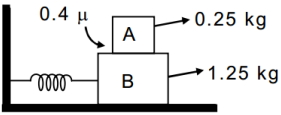
- 7The velocity of a particle in simple harmonic motion at displacement $y$ from mean position isView Solution
- 8A particle starts oscillating simple harmonically from its equilibrium position then, the ratio of kinetic energy and potential energy of the particle at the time $T/12$ is : ($T =$ time period)View Solution
- 9The length of the second pendulum on the surface of earth is $1\, m$. The length of seconds pendulum on the surface of moon, where g is 1/6th value of $g$ on the surface of earth, isView Solution
- 10The displacement $x$ (in metre) of a particle in, simple harmonic motion is related to time t (in seconds) asView Solution
$x = 0.01\cos \left( {\pi \,t + \frac{\pi }{4}} \right)$
The frequency of the motion will be