The amplitude of a damped oscillator decreases to $0.9\,times$ its original magnitude in $5\,s.$ In another $10\,s$ it will decrease to $\alpha $ times its original magnitude, where $\alpha $ equals
Medium
Download our app for free and get started
$A=A_{0} e^{-h t}$
$0.9 A_{0}=A_{0} e^{-k t}$
$-k t=\ln (0.9) \Rightarrow-15 k=3 \ln (0.9)$
$A=A_{0} e^{-15 k}=A_{0} e^{-\ln (0.9)^{3}}$
$=(0.9)^{3} A_{0}=0.729 A_{0}$
Hence,
option $(C)$ is correct answer.

Download our appand get started for free
Experience the future of education. Simply download our apps or reach out to us for more information. Let's shape the future of learning together!No signup needed.*
Similar Questions
- 1If a simple pendulum is taken to place where g decreases by $2\%$, then the time periodView Solution
- 2The potential energy of a particle executing S.H.M. is $ 2.5\, J$, when its displacement is half of amplitude. The total energy of the particle be .... $J$View Solution
- 3A body is executing simple harmonic motion with an angular frequency $2\,rad/s$. The velocity of the body at $20\, mm$ displacement, when the amplitude of motion is $60\, mm$, is ...... $mm/s$View Solution
- 4A particle is performing $S.H.M.$ with energy of vibration $90 \,J$ and amplitude $6 \,cm$. When the particle reaches at distance $4 \,cm$ from mean position, it is stopped for a moment and then released. The new energy of vibration will be ........... $J$View Solution
- 5View SolutionIn S.H.M. maximum acceleration is at
- 6A particle is executing $S.H.M.$ If its amplitude is $2 \,m$ and periodic time $2$ seconds, then the maximum velocity of the particle will beView Solution
- 7Acceleration of a particle, executing $SHM$, at it’s mean position isView Solution
- 8A simple pendulum is attached to a block which slides without friction down an inclined plane $A B C$ having an angle of inclination $\alpha$ as shown below. While the block is sliding down the pendulum oscillates in such a way that at its mean position the direction of the string isView Solution
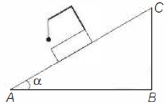
- 9The angular amplitude of a simple pendulum is $\theta_0$. The maximum tension in its string will beView Solution
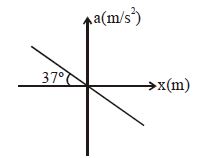
- 10The acceleration displacement graph of a particle executing $SHM$ is shown in figure. The time period of simple harmonic motion isView Solution