MCQ
The angular frequency of an AC source is $\frac{10\text{radian}}{\text{sec}}$ The reactance of $1\mu\text{F}$ capacitor will be.
- A$10^4\Omega$
- B$10^2\Omega$
- C$10^1\Omega$
- D$10^5\Omega$
Explanation:
$\text{Reactance}=\frac{1}{\text{C}\omega}\Omega$
$=\frac{1}{10^{-6}\times10}=\frac{1}{10^{-5}}$
$=10^5\Omega$
Generate a complete, print-ready paper with questions like this in minutes — across 16+ boards, with answer keys.
Radioactive nuclei that are injected into a patient collect at certain sites within its body, undergoing radioactive decay and emitting electromagnetic radiation. These radiations can then be recorded by a detector. This procedure provides an important diagnostic tool called
|
(a) Gamma camera |
(b) CAT scan |
|
(c) Radiotracer technique |
(d) Gamma ray spectroscopy |
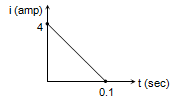
Some magnetic flux is changed from a coil of resistance 10 ohm. As a result an induced current is developed in it, which varies with time as shown in figure. The magnitude of change in flux through the coil in webers is
|
(a) 2 |
(b) 4 |
(c) 6 |
(d) None of these |
The mass number of a nucleus is
|
(a) Always less than its atomic number |
|
(b) Always more than its atomic number |
|
(c) Always equal to its atomic number |
|
(d) Sometimes more than and sometimes equal to its atomic number |
A charged particle is suspended in equilibrium in a uniform vertical electric field of intensity 20000 V/m. If mass of the particle is 9.6  , the charge on it and excess number of electrons on the particle are respectively (g =
|
(a) 4.8 |
(b) 5.8 |
(c) 3.8 |
(d) 2.8 |
An object placed 10 cm in front of a lens has an image 20 cm behind the lens. What is the power of the lens (in dioptres)
|
(a) 1.5 |
(b) 3.0 |
(c) – 15.0 |
(d) + 15.0 |


