MCQ
The angular magnification of a simple microscope can be increased by increasing
  • A
    focal length of lens
  • B
    size of object
  • C
    aperture of lens
  • power of lens

Answer

Correct option: D.
power of lens
d
To increase the angular magnification of a simple microscope,one should increase power of lens

Need a full question paper?

Generate a complete, print-ready paper with questions like this in minutes — across 16+ boards, with answer keys.
Start Generating Free

Similar questions

A cell of constant $e.m.f.$ first connected to a resistance ${R_1}$ and then connected to a resistance ${R_2}$. If power delivered in both cases is then the internal resistance of the cell is
The half-life of a radioactive element $A$ is the same as the mean-life of another radioactive element $B.$ Initially both substances have the same number of atoms, then
Where should an object be placed infront of a concave mirror of focal length $20\,cm$ so that image is $2\,times$ of the size of object
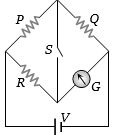
In the circuit shown $P \ne R$, the reading of the galvanometer is same with switch $S$ open or closed. Then
The Brewsters angle ${i }_{b}$ for an interface should be
A nucleus decays by ${\beta ^ + }$ emission followed by a gamma emission. If the atomic and mass numbers of the parent nucleus are $Z$ and $A$ respectively, the corresponding numbers for the daughter nucleus are respectively.
The relative permittivity of distilled water is $81 .$ The velocity of light in it will be $....\,\times 10^{7}\,{m} / {s}$

$\left(\right.$ Given $\left.\mu_{r}=1\right)$
Which of the nine planets is nearest to sun
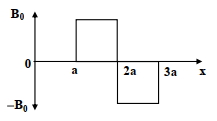
A magnetic field $\overrightarrow{\mathrm{B}}=\mathrm{B}_0 \hat{\mathrm{j}}$ exists in the region $\mathrm{a} < \mathrm{x} < 2 \mathrm{a}$ and $\vec{B}=-B_0 \hat{j}$, in the region $2 \mathrm{a} < \mathrm{x} < 3 \mathrm{a}$, where $\mathrm{B}_0$ is a positive constant. $\mathrm{A}$ positive point charge moving with a velocity $\overrightarrow{\mathrm{v}}=\mathrm{v}_0 \hat{\dot{i}}$, where $v_0$ is a positive constant, enters the magnetic field at $x=a$. The trajectory of the charge in this region can be like,
Choose the correct option about light.