MCQ
The angular momentum of a moving body remains constant, if
  • A
    net pressure is applied
  • B
    net external torque is applied
  • C
    net external force is applied
  • D
    net external torque is not applied

Need a full question paper?

Generate a complete, print-ready paper with questions like this in minutes — across 16+ boards, with answer keys.
Start Generating Free

Similar questions

The molar specific heat at constant pressure of an ideal gas is $\Big(\frac{7}{2}\text{R}\Big).$ The ratio of specific heat at constant pressure to that at constant volume is:
One mole of ideal gas goes through process $P= 2V^2/(1+V^2)\,Pa$ then change in temperature of gas when volume changes from $V= 1\,m^3$ to $2\,m^3$ is
A book is resting on a shelf that is undergoing vertical simple harmonic oscillations with an amplitude of $2.5 \,cm$. What is the minimum frequency of oscillation of the shelf for .......... $Hz$ the book will lose contact with the shelf? (Assume that, $g=10 \,ms ^{-2}$ )
The mass number of a nucleus is equal to:
A gun applies a force $F$ on a bullet which is given by $F =\left(100-0.5 \times 10^{5} t \right) N$. The bullet emerges out with speed $400 \,m / s$. Then find out the impulse exerted till force on bullet becomes zero. (in $N - s$)
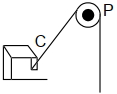
One end of massless rope, which passes over a massless and frictionless pulley $P$ is tied to a hook while the other is free. Maximum tension the rope bear is $360 N$. With what value of maximum safe acceleration (in $m s^{-2}$) can a man of $60 kg$ climb on the rope?
A disc of radius $5\, m$ is rotating with angular frequency $10\, rad / sec .$ A block of mass $2\, kg$ to be put on the disc friction coefficient between disc and block is $\mu_{ k }=0.4,$ then find the maximum distance from axis where the block can be placed without sliding (in $cm$)
A cyclist riding the bicycle at a speed of $14 \sqrt{3} \,m / s$ takes a turn around a circular road of radius $20 \sqrt{3} \,m$ without skidding. What is his inclination to the vertical?
A capacitor $C _1$ of capacitance $1 \mu F$ and a capacitor $C _2$ of capacitance $2 \mu F$ are separately charged by a common battery for a long time. The two capacitors are then separately discharged through equal resistors. Both the discharge circuits are connected at $t =0$.
$Assertion :$ A transverse waves are produced in a very long string fixed at one end. Only progressive wave is observed near the free end.
$Reason :$ Energy of reflected wave does not reach the free end.