MCQ
The angular momentum of the electron in hydrogen atom in the ground state is:
- A$2\text{h}$
- B$\frac{\text{h}}{2}$
- C$\frac{\text{h}}{2\pi}$
- D$\frac{\text{h}}{4\pi}$
Generate a complete, print-ready paper with questions like this in minutes — across 16+ boards, with answer keys.
Work function of a metal is 2.1 eV. Which of the waves of the following wavelengths will be able to emit photoelectrons from its surface
|
(a) 4000 Å, 7500 Å |
(b) 5500 Å, 6000 Å |
(c) 4000 Å, 6000 Å |
(d) None of these |
$\text{Zero.}$
$\text{v}_0$
$\sqrt2\text{v}_0$
$2\text{v}_0$
An interference pattern was made by using red light. If the red light changes with blue light, the fringes will become
|
(a) Wider |
(b) Narrower |
(c) Fainter |
(d) Brighter |
On increasing the plate separation of a charged condenser, the energy
|
(a) Increases |
(b) Decreases |
(c) Remains unchanged |
(d) Becomes zero |
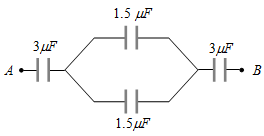
The capacitance between the points A and B in the given circuit will be
|
(a) 1 μF |
(b) 2 μF |
(c) 3 μF |
(d) 4 μF |
Assertion : Short wave bands are used for transmission of ratio waves to a large distance
Reason : Short waves are reflected by ionosphere
|
(a) If both assertion and reason are true and the reason is the correct explanation of the assertion. |
|
(b) If both assertion and reason are true but reason is not the correct explanation of the assertion. |
|
(c) If assertion is true but reason is false. |
| (d) If assertion is false but reason is true. |
Work done in moving a positive charge on an equipotential surface is
|
(a) Finite, positive but not zero |
(b) Finite, negative but not zero |
|
(c) Zero |
(d) Infinite |