MCQ
The angular speed of earth around its own axis is ......... $rad / s$
  • $\frac{\pi}{43200}$
  • B
    $\frac{\pi}{3600}$
  • C
    $\frac{\pi}{86400}$
  • D
    $\frac{\pi}{1800}$

Answer

Correct option: A.
$\frac{\pi}{43200}$
a
(a)

Angular speed $=\frac{2 \pi}{T}$

$T \rightarrow$ Time period of earth $=24 h$

$\omega=\frac{2 \pi}{24 \times 60 \times 60}=\frac{\pi}{43200} \,rad s ^{-1}$

Need a full question paper?

Generate a complete, print-ready paper with questions like this in minutes — across 16+ boards, with answer keys.
Start Generating Free

Similar questions

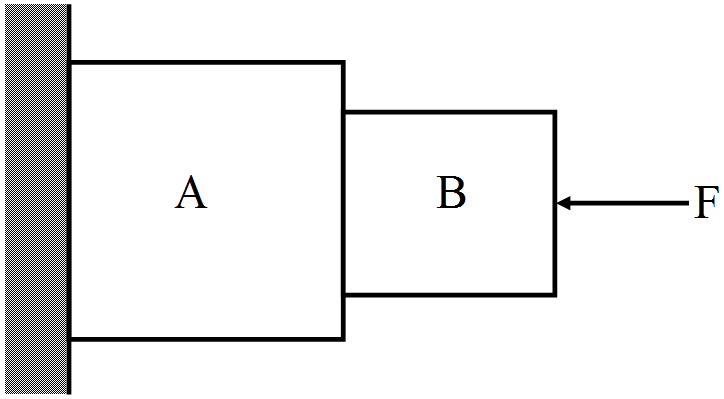
Consider the situation shown in figure. The wall smooth but the surface of A and B in contact are rough. The friction on B due to A in equilibrium:
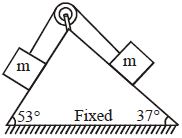
Two blocks which are connected to each other by means of a massless string are placed  on two inclined planes as shown in figure. After releasing from rest, the magnitude of  acceleration of the centre of mass of both the blocks is $(g = 10\, m/s^2)$
Which statement is incorrect?
Young's moduli of the material of wires $A$ and $B$ are in the ratio of $1: 4$, while its area of cross sections are in the ratio of $1: 3$. If the same amount of load is applied to both the wires, the amount of elongation produced in the wires $A$ and $B$ will be in the ratio of

[Assume length of wires $A$ and $B$ are same]

When a body moves in a circular path, no work is done by the force since
The proper use of lubricants cannot reduce:
One main scale division of a vernier callipers is $a$ $cm$ and $n ^{\text {th }}$ division of the vernier scale coincide with $( n -1)^{\text {th }}$ division of the main scale. The least count of the callipers in $mm$ is
A soap bubble ( surface tension $= T$) is charged to a maximum surface density of charge $ = \sigma $. When it is just going to burst. Its radius $R$ is given by
The initial velocity of a particle of mass $2\,kg$ is $(4 \hat{ i }+4 \hat{ j })\,m / s$. A constant force of $-20 \hat{ j }\,N$ is applied on the particle. Initially, the particle was at $(0,0)$. Find the $x$-coordinate of the point where its $y$-coordinate is again zero.$..........\,m$
The potential energy of a certain particle is given by $U = \frac{1}{2}\,\left( {{x^2} - {z^2}} \right)$. The force on it is