MCQ
The angular spread of central maximum, in the diffraction pattern, does not depend on ______.
- AThe distance between the slit and sources
- BWidth of slit
- CWavelength of light
- DFrequency of light
Explanation:
Angular spread of central maxima $=(\theta)=\frac{\lambda}{\text{b}}$
Where $\lambda$ = wavelength of light
b = width of slit
⇒ Clearly, it does depends on the distance between slit and sources.
Generate a complete, print-ready paper with questions like this in minutes — across 16+ boards, with answer keys.
$\text{B}_\text{y},=\text{B}_\text{y}+\frac{\text{vE}_\text{z}}{\text{c}^2}$
$\text{E}_\text{y},=\text{E}_\text{y}+\frac{\text{vB}_\text{z}}{\text{c}^2}$
$\text{B}'_\text{y}=\text{B}_\text{y}+\text{v}\text{E}_\text{z}$
$\text{E}'_\text{y}=\text{E}_\text{y}+\text{vB}_\text{z}$
The velocity of light emitted by a source S observed by an observer O, who is at rest with respect to S is c. If the observer moves towards S with velocity v, the velocity of light as observed will be
|
(a) c + v |
(b) c - v |
(c) c |
(d) |
In the given circuit, with steady current, the potential drop across the capacitor must be
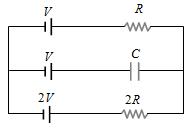
|
(a) V |
(b) V / 2 |
(c) V / 3 |
(d) 2V / 3 |
Consider a binary star system consisting of two stars of masses  and
and  separated by a distance of 30 AU with a period of revolution equal to 30 years. If one of the two stars is 5 times farther from the centre of mass than the other. The masses of the two stars in terms of solar masses are
|
(a) 5, 15 |
(b) 25, 5 |
(c) 25, 10 |
(d) 7, 25 |
If 10% of a radioactive material decays in 5 days, then the amount of original material left after 20 days is approximately
|
(a) 60% |
(b) 65% |
(c) 70% |
(d) 75% |
The energy in MeV is released due to transformation of 1 kg mass completely into energy (c = 3
| (a) 7.625 ×10 MeV |
(b) 10.5 
|
(c) 2.8 
|
(d) 5.625
|
A circular coil of radius 4 cm has 50 turns. In this coil a current of 2 A is flowing. It is placed in a magnetic field of 0.1  . The amount of work done in rotating it through 180° from its equilibrium position will be
|
(a) 0.1 J |
(b) 0.2 J |
(c) 0.4 J |
(d) 0.8 J |
