MCQ
The angular spread of central maximum, in the diffraction pattern, does not depend on ______.
- AThe distance between the slit and sources
- BWidth of slit
- CWavelength of light
- DFrequency of light
Explanation:
Angular spread of central maxima $=(\theta)=\frac{\lambda}{\text{b}}$
Where $\lambda$ = wavelength of light
b = width of slit
⇒ Clearly, it does depends on the distance between slit and sources.
Generate a complete, print-ready paper with questions like this in minutes — across 16+ boards, with answer keys.
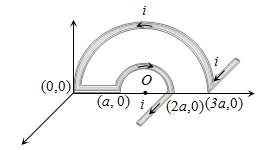
In the given figure net magnetic field at O will be
(a)  
|
(b) 
|
(c) |
(d) |
In a concave mirror experiment, an object is placed at a distance  from the focus and the image is formed at a distance
  from the focus. The focal length of the mirror would be
|
(a) |
(b) |
(c) |
(d) |
$\text{p}=\text{p}_0\sin(\text{kx}-\omega\text{t})$
$\text{p}=\text{p}_0\sin\text{kx}\cos\omega\text{t}$
$\text{p}=\text{p}_0\cos\text{kx}\sin\omega\text{t}$
$\text{p}=\sum\text{p}_{0\text{n}}\sin(\text{k}_\text{n}\text{x}-\omega_\text{n}\text{t}).$
What is the equivalent resistance between A and B

|
(a) |
(b) |
(c) |
(d) 2R |
Peltier co-efficient of a thermo couple is 2 nano volts. How much heat is developed at a junction if 2.5 amp current flows for 2 minute
|
(a) 6 ergs |
(b) 6 |
(c) 16 ergs |
(d) 6 |
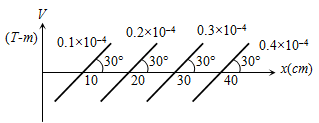
Some equipotential surfaces of the magnetic scalar potential are shown in the figure. Magnetic field at a point in the region is
|
(a) |
(b) 2 |
(c) 0.5 |
(d) None of these |


