Question
The area bounded by lines y=x and x = 2 in first quadrant is

Answer

self

Need a full question paper?

Generate a complete, print-ready paper with questions like this in minutes — across 16+ boards, with answer keys.
Start Generating Free

Similar questions

The value of $\big[\vec{\text{a}}-\vec{\text{b}},\vec{\text{b}}-\vec{\text{c}},\vec{\text{c}}-\vec{\text{a}}\big],$ where $\big|\vec{\text{a}}\big|=1,\big|\vec{\text{b}}\big|=5,\big|\vec{\text{c}}\big|=3,$ is:
  1. 0
  2. 1
  3. 6
  4. None of these.
The shortest distance between the lines $\frac{\text{x}-3}{3}=\frac{\text{y}-8}{-1}=\frac{\text{z}-3}{1}$ and, $\frac{\text{x}+3}{-3}=\frac{\text{y}+7}{2}=\frac{\text{z}-6}{4}$ is:
Can $\frac{1}{\sqrt{3}},\frac{2}{\sqrt{3}},\frac{-2}{\sqrt{3}}$ be the direction cosines of any directed line:
  1. Yes
  2. No
  3. Cannot say
  4. None of these
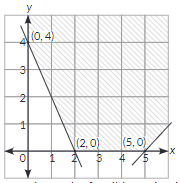
A linear programming problem (LPP) along with the graph of its constraints is shown below. The corresponding objective function is
Minimize: $Z=3 x+2 y$. The minimum value of the objective function is obtained at the corner point ( 2 , 0).
The optimal solution of the above linear programming problem $\qquad$
Image
The value of the cofactor of the element of second row and third column in the matrix $\left[\begin{array}{ccc}4 & 3 & 2 \\ 2 & -1 & 0 \\ 1 & 2 & 3\end{array}\right]$ is:
If $y=\sin x^{\circ}$ then the value of $\frac{d y}{d x}$ is
The values of the constants a, b and for which the function $\text{f(x)}=\begin{cases}(1+\text{ax})^{\frac{1}{\text{x}}},&\text{x}>0\\\text{b},&\text{x}=0\\\frac{(\text{x}+\text{c})^{\frac{1}{2}}-1}{(\text{x}+1)^{\frac{1}{2}}-1},&\text{x}>0\end{cases}$ may be continuous at x = 0, are:
  1. $\text{a}=\log_{\text{e}}\Big(\frac{2}{3}\Big),\text{ b}=-\frac{2}{3},\text{ c}=1$
  2. $\text{a}=\log_{\text{e}}\Big(\frac{2}{3}\Big),\text{ b}=\frac{2}{3},\text{ c}=-1$
  3. $\text{a}=\log_{\text{e}}\Big(\frac{2}{3}\Big),\text{ b}=\Big(\frac{2}{3}\Big),\text{ c}=1$
  4. none of these
The solution of the differential equation $(\text{x}^{2}+1)\frac{\text{dy}}{\text{dx}}+(\text{y}^{2}+1)=0$ is:  
  1. $\text{y}=2+\text{x}^{2}$
  2. $\text{y}=\frac{1+\text{x}}{1-\text{x}}$ 
  3. $\text{y}=\text{x}(\text{x}-1)$
  4. $\text{y}=\frac{1+\text{y}}{1-\text{y}}$ 
The interval in which the function $f(x)=2 x^3+9 x^2+$ $12 x-1$ is decreasing, is
If $\tan^{-1}(\text{x}-1)+\tan^{-1}\text{x}+\tan^{-1}(\text{x}+1)=\tan^{-1}3\text{x},$ then the values of x are:
  1. $\pm\frac{1}{2}$
  2. $0,\frac{1}{2}$
  3. $0,-\frac{1}{2}$
  4. $0,\pm\frac{1}{2}$