MCQ
The average acceleration vector for a particle having a uniform circular motion is
  • A
    A constant vector of magnitude $\frac{{{v^2}}}{r}$
  • B
    A vector of magnitude $\frac{{{v^2}}}{r}$ directed normal to the plane of the given uniform circular motion
  • C
    Equal to the instantaneous acceleration vector at the start of the motion
  • A null vector

Answer

Correct option: D.
A null vector
d
(d)In complete revolution change in velocity becomes zero so average acceleration will be zero.

Need a full question paper?

Generate a complete, print-ready paper with questions like this in minutes — across 16+ boards, with answer keys.

Start Generating Free

Similar questions

Moment of inertia of a body about a given axis is $1.5\, kg\, m^2$ Initially the body is at rest. In order to produce a rotational kinetic energy of $1200\, J$, the angular acceleration of $20\, rad/s^2$ must be applied about the axis of rotation for a duration of ......... $\sec$.
A uniform rope of mass $1.0\, kg$ is connected with a box of mass $2.0\, kg$, which is placed on a smooth horizontal surface. The free end of the rope is pulled horizontally by a force $6\, N$. Find the tension at the midpoint of the rope ....... $N$
The intensity level due to two waves of the same frequency in a given medium are $1\, bel$ and $5\, bel$. Then the ratio of amplitudes is
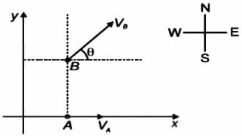
Figure shows two ships moving in $x-y$ plane with velocities $V_A$ and $V_B$. The ships move such that $B$ always remains north of $A$. The ratio $\frac{V_A}{V_B}$ is equal to ........
A ball of mass $2\,kg$ and another of mass $4\,kg$ are dropped together from a $60$ feet tall building. After a fall of $30$ feet each towards earth, their respective kinetic energies will be in the ratio of
The pressure $P$ and density $p$ of a gas are related as:
If a body $A$ of mass $M$ is thrown with velocity $v$ at an angle of ${30^o}$ to the horizontal and another body $B$ of the same mass is thrown with the same speed at an angle of ${60^o}$ to the horizontal. The ratio of horizontal range of $A$ to $B$ will be
A wire is suspended from the ceiling and stretched under the action of a weight $F$ suspended from its other end. The force exerted by the ceiling on it is equal and opposite to the weight.
The ratio of the speed of a projectile at the point of projection to the speed at the top of its trajectory is $x$. The angle of projection with the horizontal is
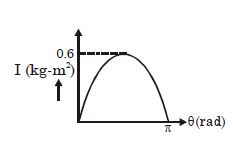
Figure shows the variation of the moment of inertia of a uniform rod, about an axis passing through its centre and inclined at an angle $\theta$ to the length. The moment of inertia of the rod about an axis passing through one of its ends and making an angle $\theta  = \frac{\pi }{3}$ will be ........ $ kg-m^2$.