MCQ
The average acceleration vector for a particle having a uniform circular motion is
  • A
    A constant vector of magnitude $\frac{{{v^2}}}{r}$
  • B
    A vector of magnitude $\frac{{{v^2}}}{r}$ directed normal to the plane of the given uniform circular motion
  • C
    Equal to the instantaneous acceleration vector at the start of the motion
  • A null vector

Answer

Correct option: D.
A null vector
d
(d)In complete revolution change in velocity becomes zero so average acceleration will be zero.

Need a full question paper?

Generate a complete, print-ready paper with questions like this in minutes — across 16+ boards, with answer keys.

Start Generating Free

Similar questions

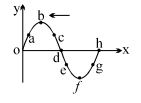
The figure represents the instantaneous picture of a transverse harmonic wave traveling along the negative $x$-axis. Choose the correct alternative $(s)$ related to the movement of the nine points shown in the figure. The points moving upward is/are
A  refrigerator works between $4^o C$ and $30^o C.$  It is required to remove $600$ calories of heat every second in order to keep the temperature of the refrigerated space constant. The power required is ....... $W$ (Take $1\, cal \,=\, 4.2\, Joules\,)$ 
When a capillary is dipped in water, water rises to a height $h$. If the length of the capillary is made less than $h$, then
A girl holds a book of mass $m$ against a vertical wall with a horizontal force $F$ using her finger, so that the book does not move. The frictional force on the book by the wall is
There is some liquid in a closed bottle. The amount of liquid remains constant as time passes. The vapour in the remaining part:
Which of the following shows the correct relationship between the pressure $'P'$ and density $\rho $ of an ideal gas at constant temperature ?
If the value of moment of inertia of a solid sphere relative to its diameter is I, then the moment of inertia of the sphere relative to its tangent line will be:
A space-ship moves from the earth to the moon and back. The greatest energy required for the space-ship is to overcome the difficulty in
The maximum height reached by a projectile is $64 \mathrm{~m}$. If the initial velocity is halved, the new maximum height of the projectile is_________.$\mathrm{m}$.
Heat given to a system is $35$ joules and work done by the system is $15$ joules. The change in the internal energy of the system will be ..... $J$