MCQ
The average kinetic energy of a cup doing simple harmonig motion will be :
  • $\frac{1}{4} kA ^2$
  • B
    $\frac{1}{2} kA ^2$
  • C
    $kA ^2$
  • D
    none of these

Answer

Correct option: A.
$\frac{1}{4} kA ^2$
(A)

Need a full question paper?

Generate a complete, print-ready paper with questions like this in minutes — across 16+ boards, with answer keys.

Start Generating Free

Similar questions

A tank with a small hole at the bottom has been filled with water and kerosene (specific gravity $0.8$). The height of water is $3\,m$ and that of kerosene $2\,m$. When the hole is opened the velocity of fluid coming out from it is nearly ........ $ms^{-1}$ .(take $g\, = 10\, m s^{-2}$ and density of water $= 10^3\, kg\, m^{-3}$)
A particle is acted upon by a force of constant magnitude which is always perpendicular to the velocity of the particle. The motion of the particle takes place in a plane. It follows that:
If force $({F})$, length $({L})$ and time $({T})$ are taken as the fundamental quantities. Then what will be the dimension of density
If a body is charged by rubbing it, its weight
A particle $(A)$ moves due north at $3\,km / h$ another particle $(B)$ due west at $4\,km / h$. The relative velocity of $A$ with respect to $B$ is $\left(\tan 37^{\circ}=3 / 4\right)$
A carnot engine is made to work between $200\,^oC$ and $0\,^oC$ first and then between $0\,^oC$ and $-200\,^oC$. The ratio of efficiencies $\left( {\frac{{{\eta _2}}}{{{\eta _1}}}} \right)$ of the engine in two cases is
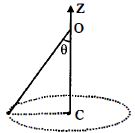
A conical pendulum of length $1\,m$ makes an angle $\theta \, = 45^o$ w.r.t. $Z-$ axis and moves in a circle in the $XY$ plane.The radius of the circle is $0.4\, m$ and its centre is vertically below $O$. The speed of the pendulum, in its circular path, will be ..... $m/s$ (Take $g\, = 10\, ms^{-2}$)
The graphs in figure show that a quantity $y$ varies with displacement $d$ in a system undergoing simple harmonic motion. Which graphs best represents the relationship obtained when $y$ is The time
A solid body rotates about a fixed axis such that its angular velocity depends on $\theta$ as $\omega=k \theta^{-1}$ where $k$ is a positive constants. At $t=0, \theta=0$, then time dependence of $\theta$ is given as ..........
Ultrasonic waves are those waves