Question
The below diagram represents a plant cell after being placed in a strong sugar solution. Guidelines 1 to 5 indicate the following:
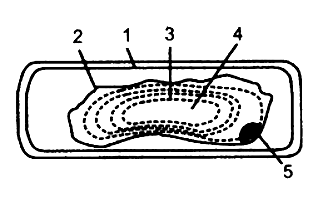
1. Cell wall
2. Plasma membrane.
3. Protoplasm
4. Large vacuole
5. Nucleus
Study the diagram and answer the questions that follow :
(i) What is the state of the cell shown in the diagram?
(ii) Name the structure which acts as a selectively permeable membrane.
(iii) If the cell had been placed in distilled water instead of a strong sugar solution which features: would not have been present?
(iv) If the cell in the diagram possessed chloroplasts where would these be present?
(v) Name any one feature of this plant cell which is not present in animal cells.
Answer

(i) Flaccid.
(ii) Plasma membrane.
(iii) If the cell had been placed in distilled water it remains in a fully distended condition. Its plasma membrane remains in close contact with the cell wall and presses against it.
(iv) Chloroplast will be present in the protoplasm outside the vacuole.
(v) Cell wall.

Need a full question paper?

Generate a complete, print-ready paper with questions like this in minutes — across 16+ boards, with answer keys.

Start Generating Free

Similar questions

Differentiate between:
Blood and Lymph.
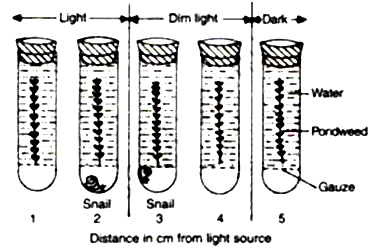
The diagram is set up to demonstrate an experiment. Pond weed was placed in five water-filled tubes. The experiment was set up as shown in the diagram. The tubes were then left for 24 hours. Write the correct answer out of the five available choices:
(i) In which tube would you except to find the plant with the least amount of starch?
(a ) 1 (b) 2 (c) 3 (d) 4 (e ) 5
(ii) The tube in which most oxygen would be found is
(a ) 1 (b) 2 (c) 3 (d) 4 (e ) 5
(iii) The tube in which least carbon dioxide would be found is
(a ) 1 (b) 2 (c) 3 (d) 4 (e ) 5
(iv) The tube in which the plant would survive for the shortest length of time is
(a ) 1 (b) 2 (c) 3 (d) 4 (e) 5
Name the stimulus which causes the following movements in plants.
phototropism,thigmotropism, hydrotropism and geotropism
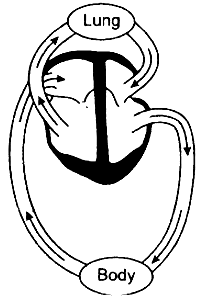
The diagram represents the ‘closed system’ or ‘double circulation’ of blood in mammals.

Justify the above statement.
State two structural and two functional differences between the arteries and veins.
State the changes in the composition of blood as it passes through the following organs:
$(a)$ Lungs $(b)$ Gut $(c)$ Liver $(d)$ Kidneys.
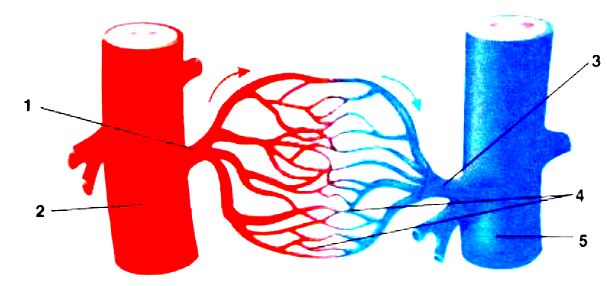
Given below is a diagrammatic representation of certain types of blood vessels in human body.
Identify the types of blood vessels numbered 1 to 5.
How many daughter cells would you expect if 4 cells undergo
(i) Mitosis
(ii) Meiosis
(iii) Amitosis
What is the significance of meiosis?
Complete the following table by filling in the blank spaces.
StructureFunction
Yellow Spot
Transfers impulse from inner ear to brain
Helps to change the focal length of the eye lens
Spinal cord
Oval window
Dynamic equilibrium
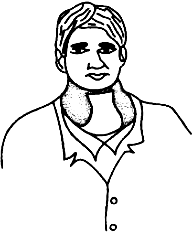
The sketch below shows a certain condition in an individual:

(i) Name the condition.
(ii) What is the underlying cause of this condition?
(iii) Name two other conditions that could have resulted due to a similar cause.
(iv) Which hormone is required for iodine synthesis?
(v) Where is the thyroid gland located?
(vi) The hormone secreted by the thyroid gland is controlled from which hormone?