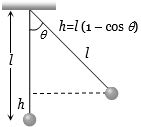
The bob of simple pendulum having length $l$, is displaced from mean position to an angular position $\theta$ with respect to vertical. If it is released, then velocity of bob at lowest position
AIPMT 2000, Medium
Download our app for free and get startedPlay store
(c)If suppose bob rises up to a height h as shown then after releasing potential energy at extreme position becomes kinetic energy of mean position
$ \Rightarrow mgh = \frac{1}{2}mv_{\max }^2$

$ \Rightarrow {v_{\max }} = \sqrt {2gh} $
Also, from figure $\cos \theta = \frac{{l - h}}{l}$
$ \Rightarrow h = l(1 - \cos \theta )$
So, ${v_{\max }} = \sqrt {2gl(1 - \cos \theta )} $
art

Download our app
and get started for free

Experience the future of education. Simply download our apps or reach out to us for more information. Let's shape the future of learning together!No signup needed.*

Similar Questions

  • 1
    A pendulum has time period $T$ in air. When it is made to oscillate in water, it acquired a time period $T' = \sqrt 2 T$. The density of the pendulum bob is equal to (density of water $= 1$)
    View Solution
  • 2
    The particle executing simple harmonic motion has a kinetic energy $K_0cos^2 \omega t$. The maximum values of the potential energy and the total energy are respectively
    View Solution
  • 3
    Values of the acceleration $A$ of a particle moving in simple harmonic motion as a function of its displacement $x$ are given in the table below. The period of the motion is

    $A (mm \,\,s^{-2}$)

     $16$

        $8$

    $0$

    $- 8$

    $- 16$

    $x\;(mm)$

    $- 4$

    $- 2$

    $0$

      $2$

       $4$

    View Solution
  • 4
    If a particle is executing simple harmonic motion, then acceleration of particle
    View Solution
  • 5
    On a frictionless horizontal plane, a bob of mass $m=0.1 kg$ is attached to a spring with natural length $l_0=0.1 m$. The spring constant is $k_1=0.009 Nm ^{-1}$ when the length of the spring $I > l_0$ and is $k_2=0.016 Nm ^{-1}$ when $ I < l_0$. Initially the bob is released from $l=0.15 m$. Assume that Hooke's law remains valid throughout the motion. If the time period of the full oscillation is $T=(n \pi) s$, then the integer closest to $n$ is. . . . .
    View Solution
  • 6
    A mass $m$ attached to a spring oscillates every $2\, sec$. If the mass is increased by $2 \,kg$, then time-period increases by $1\, sec$. The initial mass is ..... $kg$
    View Solution
  • 7
    The displacement of an oscillator is given by $x = a\, \sin \, \omega t + b\, \cos \, \omega t$. where $a, b$ and $\omega$ are constant. Then :-
    View Solution
  • 8
    A coin is placed on a horizontal platform which undergoes vertical simple harmonic motion of angular frequency $\omega $. The amplitude of oscillation is gradually increased. The coin will leave contact with the platform for the first time
    View Solution
  • 9
    Two particles oscillating in $SHM$ along two very close parallel path such that they have same mean position. The equation of $SHM$ of two particles are $x_1 = A\, sin\,\omega t$ and $x_2 = A\,sin(\omega t + \phi )$ respectively. If maximum distance between them is $\frac{6A}{5}$ then $\phi $ equal to ..... $^o$
    View Solution
  • 10
    A particle of mass $10\, gm$ is describing $S.H.M.$ along a straight line with period of $2\, sec$ and amplitude of $10, cm$. Its kinetic energy when it is at $5 \,cm$ from its equilibrium position is
    View Solution