MCQ
The capacitor offers zero resistance to.
- AD.C. only
- BA.C. & D.C.
- CA.C. only
- Dneither A.C. nor D.C.
Explanation:
Capacitive reactance is given as
$\text{X}_\text{C}=\frac{1}{\omega\text{C}}$From this relation we can see that the value of capacitive reactance and therefore its overall impedance (in Ohms) decreases to zero as the frequency increases acting like a short
circuit. Likewise, as the frequency approaches zero or DC, the capacitors reactance increases to infinity, acting like an open circuit which is why capacitors block DC.
Generate a complete, print-ready paper with questions like this in minutes — across 16+ boards, with answer keys.
A battery of internal resistance 4W is connected to the network of resistances as shown. In order to give the maximum power to the network, the value of R (in Ω) should be

|
(a) 4/9 |
(b) 8/9 |
(c) 2 |
(d) 18 |
A straight wire carrying a current 10 A is bent into a semicircular arc of radius 5 cm. The magnitude of magnetic field at the center is
|
(a) 1.5 |
(b) 3.14 |
(c) 6.28 |
(d) 19.6 |
An electric charge q is placed at the centre of a cube of side α. The electric flux on one of its faces will be
|
(a) |
(b) |
(c) |
(d) |
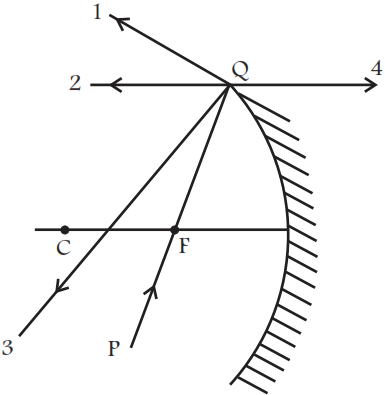
The direction of ray of light incident on a concave mirror is shown by PQ while directions in which the ray would travel after reflection is shown by four rays marked 1, 2, 3 and 4 (Fig). Which of the four rays correctly shows the direction of reflected ray?
The lowest resistance which can be obtained by connecting 10 resistors each of 1/10 ohm is
|
(a) 1/250 Ω |
(b) 1/200 Ω |
(c) 1/100 Ω |
(d) 1/10 Ω |


