MCQ
The carbonate which does not leave a residue on heating is
- A$N{a_2}C{O_3}$
- B$A{g_2}C{O_3}$
- C$CuC{O_3}$
- ✓${(N{H_4})_2}C{O_3}$
$B] \,Ag _2 CO _3 \stackrel{\Delta}{\longrightarrow} Ag ( s )+ CO _2( g )$
$C] \,Cu _2 CO _3 \stackrel{\Delta}{\longrightarrow} CuO ( s )+ CO _2( g )$
$D] \,\left( NH _4\right)_2 CO _3 \stackrel{\Delta}{\longrightarrow} NH _3( g )+ CO _2( g )$
So, residue is not left in [$D$].
Generate a complete, print-ready paper with questions like this in minutes — across 16+ boards, with answer keys.
$\begin{array}{*{20}{c}}
{Ph - CH = CH - CH - C = O\xrightarrow[{PH = 4.5}]{{{H_2}N - OH}}} \\
{{\mkern 1mu} {\mkern 1mu} \,\,\,\,\,\,\,\,\,\,\,\,\,\,\,\,\,\,\,\,|\,\,\,\,\,\,\,\,\,\,\,\,\,\,\,|{\mkern 1mu} {\mkern 1mu} {\mkern 1mu} {\mkern 1mu} {\mkern 1mu} {\mkern 1mu} {\mkern 1mu} {\mkern 1mu} {\mkern 1mu} {\mkern 1mu} {\mkern 1mu} {\mkern 1mu} {\mkern 1mu} {\mkern 1mu} {\mkern 1mu} {\mkern 1mu} {\mkern 1mu} {\mkern 1mu} {\mkern 1mu} {\mkern 1mu} {\mkern 1mu} {\mkern 1mu} {\mkern 1mu} {\mkern 1mu} {\mkern 1mu} } \\
{{\mkern 1mu} {\mkern 1mu} {\mkern 1mu} {\mkern 1mu} \,\,\,\,\,\,\,\,\,\,\,\,\,\,\,\,\,\,\,\,\,C{H_3}\,\,\,\,\,\,\,H{\mkern 1mu} {\mkern 1mu} \,\,{\mkern 1mu} {\mkern 1mu} {\mkern 1mu} {\mkern 1mu} {\mkern 1mu} {\mkern 1mu} {\mkern 1mu} {\mkern 1mu} {\mkern 1mu} {\mkern 1mu} {\mkern 1mu} {\mkern 1mu} {\mkern 1mu} {\mkern 1mu} {\mkern 1mu} {\mkern 1mu} {\mkern 1mu} {\mkern 1mu} {\mkern 1mu} {\mkern 1mu} {\mkern 1mu} {\mkern 1mu} {\mkern 1mu} {\mkern 1mu} }
\end{array}$ ?
Product $(A)$ is
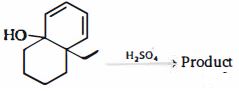
Product of the above reaction is
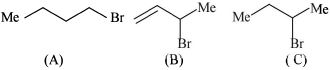
The correct order of ${S_{{N^1}}}$ reactivity is