MCQ
The Cauchy’s dispersion formula is
  • $n = A + B{\lambda ^{ - 2}} + C{\lambda ^{ - 4}}$
  • B
    $n = A + B{\lambda ^2} + C{\lambda ^{ - 4}}$
  • C
    $n = A + B{\lambda ^{ - 2}} + C{\lambda ^4}$
  • D
    $n = A + B{\lambda ^2} + C{\lambda ^4}$

Answer

Correct option: A.
$n = A + B{\lambda ^{ - 2}} + C{\lambda ^{ - 4}}$
a
( a)

Need a full question paper?

Generate a complete, print-ready paper with questions like this in minutes — across 16+ boards, with answer keys.
Start Generating Free

Similar questions

A magnet of magnetic moment M is rotated through 360° in a magnetic field H, the work done will be
Two metal spheres of capacitance ${C_1}$ and ${C_2}$ carry some charges. They are put in contact and then separated. The final charges ${Q_1}$ and ${Q_2}$ on them will satisfy
The ratio of the energy of a photon with $\lambda = 150\,nm$ to that with $\lambda = 300\,nm$ is
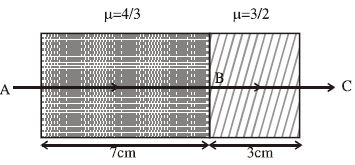
The given figure shows a ray of light passing through two media having refractive indices $4/3$ and $3/2$ respectively. The ratio of times taken by the ray in traversing the distances $AB$ and $BC$ is
The focal length of objective and eye lens of a microscope are $4\, cm$ and $8\, cm$ respectively. If the least distance of distinct vision is $24 \,cm$ and object distance is $4.5 \,cm$ from the objective lens, then the magnifying power of the microscope will be
Two bulbs, one of $50\, watt$ and another of $25\, watt$ are connected in series to the mains. The ratio of the currents through them is
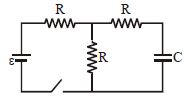
The time constant of given circuit is 
In order to increase the resistance of a given wire of uniform cross section to four times its value, a fraction of its length is stretched uniformly till the full length of the wire becomes $\frac{3}{2}$ times the original length what is the value of this fraction?
If a radioactive substance reduces to $\frac {1}{16}$ of its original mass in 40 days, what is its half-life
Concentric metallic hollow spheres of radii $R$ and $4 R$ hold charges $Q _{1}$ and $Q _{2}$ respectively. Given that surface charge densities of the concentric spheres are equal, the potential difference $V ( R )- V (4 R )$ is