MCQ
The centripetal acceleration is given by
  • $v^2/r$
  • B
    $vr$
  • C
    $vr^2$
  • D
    $v/r$

Answer

Correct option: A.
$v^2/r$
a
(a)

Need a full question paper?

Generate a complete, print-ready paper with questions like this in minutes — across 16+ boards, with answer keys.

Start Generating Free

Similar questions

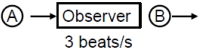
Two sources of sound $S_1$ અને $S_2$ are moving towards and away from a stationary observer with the same speed respectively. Observer detects $3$ beats per second. Find speed of source (approximately). (in $m/s$)

Given, $F 1= F 2=500\, Hz$. speed of air $=330\, m / s$
A container with rigid walls is covered with perfectly insulating material. The container is divided into two parts by a partition. One part contains a gas while the other is fully evacuated (vacuum). The partition is suddenly removed. The gas rushes to fill the entire volume and comes to equilibrium after a little time. If the gas is not ideal, then
Two astronauts are floating in gravitational free space after having lost contact with their spaceship. The two will 
A quantity $x$ is given by $\left( IF v^{2} / WL ^{4}\right)$ in terms of moment of inertia $I,$ force $F$, velocity $v$, work $W$ and Length $L$. The dimensional formula for $x$ is same as that of
The translation distances $(dx, dy)$ is called as:
The displacement $y$ of a wave travelling in $x-$direction is given by $\text{y}=10^{-4}\sin\Big(600\text{t}-2\text{x}+\frac{\pi}{3}\Big)$ where $x$ and $y$ are in metre and $t$ is in seconds. The speed of wave motion in $s^{-1}$ is:
A motor cycle driver doubles its velocity when he is having a turn. The force exerted outwardly will be
The ratio of the radii of planets $A$ and $B$ is ${k_1}$ and ratio of acceleration due to gravity on them is ${k_2}$. The ratio of escape velocities from them will be
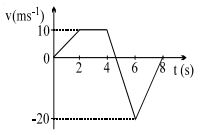
 The figure shows a velocity-time graph of a particle moving along a straight line. The particle comes to rest at $t=$ ....... $\sec$
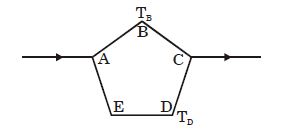
$ABCDE$ is a regular pentagon of uniform wire. The rate of heat entering at $A$ and leaving at $C$ is equal. $T_B$ and $T_D$ are temperature of $B$ and $D$ . Find the temperature $T_C$