MCQ
The centroid of a triangle, whose vertices are $(2,1)$, $(5,2)$ and $(3,4)$, is
  • A
    $\left( {\frac{8}{3},\frac{7}{3}} \right)$
  • $\left( {\frac{{10}}{3},\frac{7}{3}} \right)$
  • C
    $\left( { - \frac{{10}}{3},\frac{7}{3}} \right)$
  • D
    $\left( {\frac{{10}}{3}, - \frac{7}{3}} \right)$
Answer

Correct option: B.
$\left( {\frac{{10}}{3},\frac{7}{3}} \right)$
b
(b)$x = \frac{{2 + 5 + 3}}{3} = \frac{{10}}{3}$ and $y = \frac{{1 + 2 + 4}}{3} = \frac{7}{3}$.

Need a full question paper?

Generate a complete, print-ready paper with questions like this in minutes — across 16+ boards, with answer keys.

Start Generating Free

Similar questions

The number of distinct real roots of the equation $|\mathrm{x}+1||\mathrm{x}+3|-4|\mathrm{x}+2|+5=0$, is ...........
$^n{C_r} + {2^n}{C_{r - 1}}{ + ^n}{C_{r - 2}} = $
If ${S_n} = nP + \frac{1}{2}n(n - 1)Q$, where ${S_n}$ denotes the sum of the first $n$ terms of an $A.P.$, then the common difference is
Choose the correct answer. Distance of the point $(3, 4, 5)$ from the origin $(0, 0, 0)$ is:
The line segment joining the points (1, 2) and (-2, 1) is divided by the line 3x + 4y = 7 in the ratio:
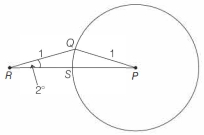
Suppose $Q$ is a point on the circle with centre $P$ and radius $1$, as shown in the figure, $R$ is a point outside the circle such that $Q R=1$ and $\angle Q R P=2^{\circ}$. Let $S$ be the point where the segment $R P$ intersects the given circle. Then, measure of $\angle R Q S$ equals $......^{\circ}$
Slope of a line which cuts intercepts of equal lengths on the axes is 
If in a group of n distinct objects, the number of arrangements of $4$ objects is $12$ times the number of arrangements of $2$ objects, then the number of objects is:
Two parallel chords of a circle of radius $2$ are at a distance $\sqrt{3}+1$ apart. If the chords subtend at the centre, angles of $\frac{\pi}{k}$ and $\frac{2 \pi}{k}$, where $\mathrm{k}>0$, then the value of $[\mathrm{k}]$ is [Note : $[\mathrm{k}]$ denotes the largest integer less than or equal to $\mathrm{k}$ ].
If ${(1 + x)^n} = {C_0} + {C_1}x + {C_2}{x^2} + .... + {C_n}{x^n}$, then ${C_0}{C_2} + {C_1}{C_3} + {C_2}{C_4} + {C_{n - 2}}{C_n}$ equals