MCQ
The characteristics of hydrogen resemble the elements of $ ......... $ as well as $ ....... $ groups :
  • A
    $\text{IIA}$ and $\text{VA}$
  • B
    $\text{IIIA}$ and $\text{VIA}$
  • C
    $\text{IIA}$ and $\text{VIA}$
  • $\text{IA}$ and $\text{VIIA}$

Answer

Correct option: D.
$\text{IA}$ and $\text{VIIA}$
Because hydrogen has $1 e^{-}$ in its outermost shell which is ready to be donated like that a group $1 A$
$($alkali metals$)$.
Also hydrogen can accept an $\mathrm{e}^{-}$ to from $\mathrm{H}^{-}$ having $2 \mathrm{e}^{-}$in outer shell which is stable this resembles to $\text{VIIA}$ group $($Halogen family$),$ as they also require only one $\mathrm{e}^{-}$ to fulfill their incomplete octet.

Need a full question paper?

Generate a complete, print-ready paper with questions like this in minutes — across 16+ boards, with answer keys.

Start Generating Free

Similar questions

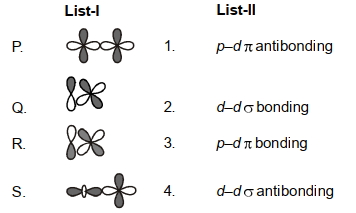
Match the orbital overlap figures shown in List-$I$ with the description given in List-$II$ and select the correct answer using the code given below the lists. $Image$

Codes: $ \quad P \quad Q \quad R \quad S $
$K _{ a_1,}, K _{ a_2 }$ and $K _{ a_3}$ are the respective ionization constants for the following reactions $(a), (b),$ and $(c)$.

$(a)$ $H _{2} C _{2} O _{4} \rightleftharpoons H ^{+}+ HC _{2} O _{4}^{-}$

$(b)$ $HC _{2} O _{4}^{-} \rightleftharpoons H ^{+}+ HC _{2} O _{4}^{2-}$

$(c)$ $H _{2} C _{2} O _{4} \rightleftharpoons 2 H ^{+}+ C _{2} O _{4}^{2-}$

The relationship between $K_{a_{1}}, K_{ a _{2}}$ and $K_{ a _{3}}$ is given as

If in the reaction ${N_2}{O_4} = 2N{O_2},\,\alpha $ is that part of ${N_2}{O_4}$ which dissociates, then the number of moles at equilibrium will be
In a reversible adiabatic process $\Delta S$ is :-
Which reactions are most common in alkenes
In $Xe{F_4}$ hybridization is
$1-$butyne reacts with cold alkaline $KMn{O_4}$ to produce
Match list $-I$ with list $-II$ and then select the correct answer from the codes given below that list

                                  List $-I$

$(A){\mkern 1mu} {\mkern 1mu} {\mkern 1mu} {C_6}{H_6} + CO + HCl\,\xrightarrow{{AlC{l_3}}}\,{C_6}{H_5}CHO$

$(B){\mkern 1mu} {\mkern 1mu} {\mkern 1mu} {C_6}{H_5} + C{H_3}$ $\xrightarrow{{Cr{O_2}C{l_2}}}\,{C_6}{H_5}CHO$

$(C){\mkern 1mu} {\mkern 1mu} {\mkern 1mu} {C_6}{H_5}C{H_2}Br\, + \,C{H_3}Br$ $\xrightarrow{{Na/ether}}\,{C_6}{H_5}C{H_2}C{H_3}$

$(D){\mkern 1mu} {\mkern 1mu} {\mkern 1mu} {C_6}{H_6}\, + \,{(C{H_3})_2}C = C{H_2}$ $\xrightarrow{{{H_2}S{O_4}}}\,{C_6}{H_5}C{(C{H_3})_3}$

                                 List $-II$
$(a)$   Friedel-Crafts reaction
$(b)$   Wurtz-Fitting reaction
$(c)$   Gattermann-Koch Aldehyde synthesis
$(d)$   Etard’s reaction

Which of the following forms the most basic hydroxide?
Ground state electronic configuration of nitrogen atom can be represented by