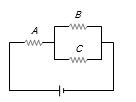
The color code of a resistance is given below
The values of resistance and tolerance, respectively, are :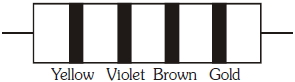
NEET 2020, Medium


Download our appand get started for free
Experience the future of education. Simply download our apps or reach out to us for more information. Let's shape the future of learning together!No signup needed.*
Similar Questions
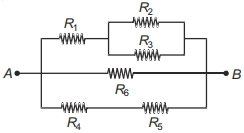
- 1View SolutionConsider the combination of resistors as shown in figure and pick out the correct statement
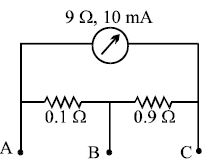
- 2A milliammeter of range $10\, mA$ and resistance $9\, \Omega$ is joined in a circuit as shown. The meter gives full-scale deflection for current $I$ when $A$ and $B$ are used as its terminals, i.e., current enters at $A$ and leaves at $B$ ($C$ is left isolated). The value of $I$ isView Solution
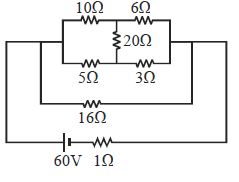
- 3The current from the cell for the given circuit is ................ $\mathrm{A}$View Solution
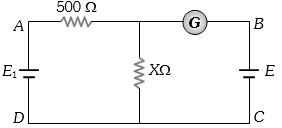
- 4In the adjoining circuit, the battery ${E_1}$ has an $e.m.f.$ of $12\,volt$ and zero internal resistance while the battery $E$ has an $e.m.f.$ of $2\,volt$. If the galvanometer $G$ reads zero, then the value of the resistance $X$ in $ohm$ isView Solution
- 5Two conductors are made of the same material and have the same length. Conductor $A$ is a solid wire of diameter $1.0\, mm$. Conductor $B$ is a hollow tube of outside diameter $2.0\, mm$ and inside diameter $1.0\, mm$. The resistance ratio $R_A/R_B$ will beView Solution
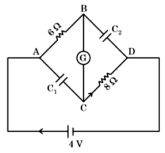
- 6In this figure the resistance of the coil of galvanometer $G$ is $2\,\Omega$. The emf of the cell is $4\,V$. The ratio of potential difference across $C_1$ and $C_2$ is:View Solution
- 7View SolutionThe maximum current that flows through a fuse wire before it blows out varies with its radius as
- 8The resistivity of a potentiometer wire is $40 \times {10^{ - 8}}\,ohm - m$ and its area of cross-section is $8 \times {10^{ - 6}}\,{m^2}$. If $0.2\, amp$ current is flowing through the wire, the potential gradient will beView Solution
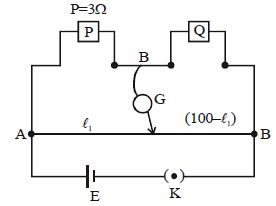
- 9In a meter bridge experiment, resistances are connected as shown in the following figure. The balancing length $l_1$ is $55\, cm$. Now, an unknown resistance $x$ is connected in series with $P$ and the new balancing length is found to be $75\, cm$. The value of $x$ isView Solution
- 10Three identical resistances $A$, $B$ and $C$ are connected as shown in the given figure. The heat produced will be maximumView Solution