MCQ
The composition of an $\alpha $- particle can be expressed as
  • A
    $1P + 1N$
  • B
    $1P + 2N$
  • C
    $2P + 1N$
  • $2P + 2N$

Answer

Correct option: D.
$2P + 2N$
d
(d)

Need a full question paper?

Generate a complete, print-ready paper with questions like this in minutes — across 16+ boards, with answer keys.

Start Generating Free

Similar questions

An elastic spring under tension of $3 \mathrm{~N}$ has a lengtha. Its length is $b$ under tension $2 \mathrm{~N}$. For its length$(3 a-2 b)$, the value of tension will be_______. $\mathrm{N}$.
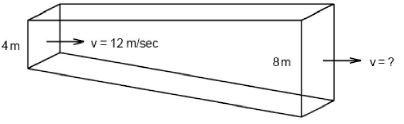
A river gradually deepens, from a depth of $4 \ m$ to a depth of $8\  m$ as shown. The width, $W$, of the river does not change. At the depth of $4 \ m$, the river's speed is $12\  m/sec.$ Its  elocity at the $8\  m$ depth is ......... $m/sec$
From a tower of height $H$, a particle is thrown vertically upwards with a speed $ u$. The time taken by the particle, to hit the ground, is $n$ times that taken by it to reach the highest point of its path. The relation between $H, u$ and $n$ is:
A man having height $6 m.$ He observes image of $2 m$ height erect, then mirror used is
A series $L-R$ circuit is connected to a battery of emf $V$. If the circuit is switched on at $t =0$, then the time at which the energy stored in the inductor reaches $\left(\frac{1}{n}\right)$ times of its maximum value, is 
The length of the wire is doubled. Its conductance will be
In an interference experiment, third bright fringe is obtained at a point on the screen with a light of $700 \,nm$. What should be the wavelength of the light source in order to obtain 5th bright fringe at the same point......$nm$
A thin cylindrical rod of length $10\,cm$ is placed horizontally on the principle axis of a concave mirror of focal length $20\,cm$. The rod is placed in a such a way that mid point of the rod is at $40\,cm$ from the pole of mirror. The length of the image formed by the mirror will be $\frac{x}{3} cm$. The value of $x$ is $............$.
The focal length of the objective and eye piece of a telescope are respectively $60 \,cm$ and $10\, cm$. The magnitude of the magnifying power when the image is formed at infinity is 
On any planet, the presence of atmosphere implies (${C_{rms}}$= root mean square velocity of molecules and ${V_e}$= escape velocity)