The composition of two simple harmonic motions of equal periods at right angle to each other and with a phase difference of $\pi $ results in the displacement of the particle along
AIPMT 1990, Medium
Download our app for free and get started
(a) If ${y_1} = {a_1}\sin \omega \,t$ and ${y_2} = {a_2}\sin (\omega \,t + \pi )$
==> $\frac{{{y_1}}}{{{a_1}}} + \frac{{{y_2}}}{{{a_2}}} = 0$
==> $\frac{{{y_1}}}{{{a_1}}} + \frac{{{y_2}}}{{{a_2}}} = 0$
==> ${y_2} = - \frac{{{a_2}}}{{{a_1}}}{y_1}$
This is the equation of straight line.

Download our appand get started for free
Experience the future of education. Simply download our apps or reach out to us for more information. Let's shape the future of learning together!No signup needed.*
Similar Questions
- 1Two pendulums differ in lengths by $22\,cm$ . They oscillate at the same place such that one of them makes $15\,oscillations$ and the other makes $18\,oscillations$ during the same time. The lengths (in $cm$ ) of the pendulums areView Solution
- 2Time period of a particle executing $SHM$ is $8\, sec.$ At $t = 0$ it is at the mean position. The ratio of the distance covered by the particle in the $1^{st}$ second to the $2^{nd}$ second is :View Solution
- 3A rod of mass $‘M’$ and length $‘2L’$ is suspended at its middle by a wire. It exhibits torsional oscillations; If two masses each of $‘m’$ are attached at distance $‘L/2’$ from its centre on both sides, it reduces the oscillation frequency by $20\%$. The value of ratio $m/M$ is close toView Solution
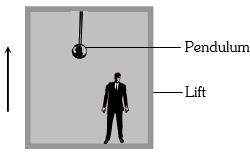
- 4A man measures the period of a simple pendulum inside a stationary lift and finds it to be $T$ sec. If the lift accelerates upwards with an acceleration $\frac{g}{4}$, then the period of the pendulum will beView Solution
- 5If displacement $x$ and velocity $v$ are related as $4v^2 = 16\, -\, x^2$ in a $SHM$ . Then time period of given $SHM$ is (consider $SI\,units$ )View Solution
- 6View SolutionA system exhibiting S.H.M. must possess
- 7An object of mass $m$ is suspended at the end of a massless wire of length $L$ and area of cross$-$section, $A$. Young modulus of the material of the wire is $Y$. If the mass is pulled down slightly its frequency of oscillation along the vertical direction isView Solution
- 8A simple pendulum is suspended in a car. The car starts moving on a horizontal road according to equation $x\, = \,\frac{g}{2}\,\sqrt 3 {t^2}$. Find the time period of oscillation of the pendulum.View Solution
- 9A particle of mass m is attached to a spring (of spring constant k) and has a natural angular frequency ${\omega _0}$ - An external force $F (t)$ proportional to $\cos \omega \,t((\omega \ne {\omega _0})$ is applied to the oscillator. The time displacement of the oscillator will be proportional toView Solution
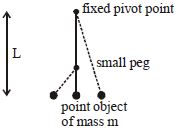
- 10A simple pendulum of length $L$ is constructed from a point object of mass $m$ suspended by a massless string attached to a fixed pivot point. $A$ small peg is placed a distance $2L/3$ directly below the fixed pivot point so that the pendulum would swing as shown in the figure below. The mass is displaced $5$ degrees from the vertical and released. How long does it take to return to its starting position?View Solution