MCQ
The correct curve representing the variation of capacitive reactance Xc with frequency f is.
- A
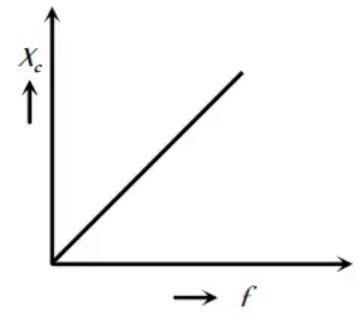
- B
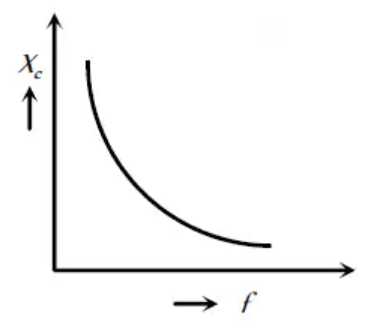
- C
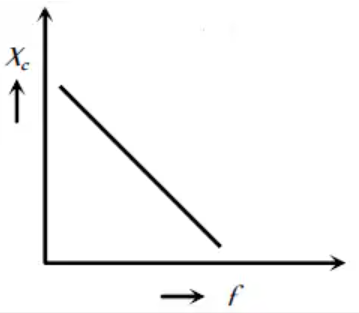
- D
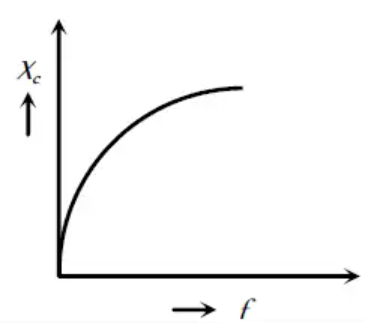
Explanation:
$\text{X}_\text{C}=\frac{1}{\text{C}2\pi\text{f}}$
XC and f are inversely proportional.
Generate a complete, print-ready paper with questions like this in minutes — across 16+ boards, with answer keys.
Which one of the following statements is correct
|
(a) In vacuum, the speed of light depends upon frequency |
|
(b) In vacuum, the speed of light does not depend upon frequency |
|
(c) In vacuum, the speed of light is independent of frequency and wavelength |
|
(d) In vacuum, the speed of light depends upon wavelength |
A silver ball of radius 4.8 cm is suspended by a thread in the vacuum chamber. UV light of wavelength 200 nm is incident on the ball for some times during which a total energy of 1 × 10⁻⁷ J falls on the surface. Assuming on an average one out of 103 photons incident is able to eject electron. The potential on sphere will be
|
(a) 1 V |
(b) 2 V |
(c) 3 V |
(d) Zero |
If n, e, τ and m respectively represent the density, charge relaxation time and mass of the electron, then the resistance of a wire of length l and area of cross-section A will be
|
(a) |
(b) |
(c) |
(d) |
In a certain charge distribution, all points having zero potential can be joined by a circle S. Points inside S have positive potential and points outside S have negative potential. A positive charge, which is free to move, is placed inside S
|
(a) It will remain in equilibrium |
|
(b) It can move inside S, but it cannot cross S |
|
(c) It must cross S at some time |
|
(d) It may move, but will ultimately return to its starting point |
In the following arrangement y = 1.0 mm, d = 0.24 mm and D = 1.2 m. The work function of the material of the emitter is 2.2 eV. The stopping potential V needed to stop the photo current will be
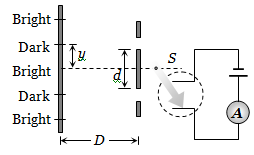
|
(a) 0.9 V |
(b) 0.5 V |
(c) 0.4 V |
(d) 0.1 V |


