MCQ
The correct difference between first- and second-order reaction is that
  • A
    the rate of a first-order reaction does not depend on reactant concentration; the rate of a secondorder reaction does depend on reactant concentrations
  • the half-life of a first-order reaction does not depend on $[A]_0$; the half-life of a second-order reaction does depend on $[A]_0$
  • C
    first-order reaction can be catalyzed; a second-order reaction cannot be catalyzed.
  • D
    the rate of a first-order reaction does depend on reactant concentrations; the rate of a second-order reaction does not depend on reactant concentrations
Answer

Correct option: B.
the half-life of a first-order reaction does not depend on $[A]_0$; the half-life of a second-order reaction does depend on $[A]_0$
b
$\left(\mathrm{t}_{1 / 2}\right) 1^{\mathrm{st}}$ order $=$ Independent of Concentration

$\left(\mathrm{t}_{1 / 2}\right) 2^{\mathrm{nd}}$ order $\propto \frac{1}{[\mathrm{A}]_{0}}$

Need a full question paper?

Generate a complete, print-ready paper with questions like this in minutes — across 16+ boards, with answer keys.

Start Generating Free

Similar questions

The rate of certain reaction depends on concentration according to the equation $\frac{{ - dc}}{{dt}} = \frac{{{K_1}C}}{{1 + {K_2}C}},$ what is the order, when concentration $(c)$ is very-very high
Two open beakers one containing a solvent and the other containing a mixture of that solvent with a non volatile solute are together sealed in a container. Over time
The function of $DNA$ in an organism is
Which one of the following orders presents the correct sequence of the increasing basic nature of the given oxides ?
The $pH$ of a solution having $[{H^ + }] = 10 \times {10^{ - 4}}\,\,moles/litre$ will be
In a saturated solution of the sparingly soluble strong electrolyte $AgIO_3$ (molecular mass $= 283$) the equilibrium which sets in is

$AgIO_{3(s)} \rightleftharpoons  Ag^+_{(aq)} +IO^-_{3(aq)}.$ 

If the solubility product constant $K_{sp}$ of $AgIO_3$ at a given temperature is $1. 0 \times 10^{-8},$ what is the mass of $AgIO_3$ contained in $100\, ml$ of its saturated saolution ?

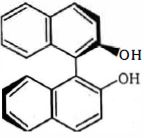
The binaphthol $(Bnp)$ is
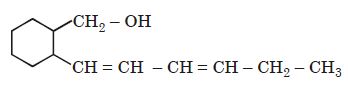
Total number of stereo-isomers possible for the following compound is
$50\, mL$ of $0.1\, M$ solution of a salt reacted with $25\, mL$ of $0.1\, M$ solution of sodium sulphite. The half reaction for the oxidation of sulphite ion is

$SO{{_{3}^{2-}}_{\left( aq. \right)}}+{{H}_{2}}{{O}_{\left( l \right)}}\to SO{{_{4}^{2-}}_{\left( aq. \right)}}+2{{H}^{+}}_{\left( aq. \right)}+2{{H}^{+}}_{\left( aq. \right)}+2{{e}^{-}}$

If the oxidation number of metal in the salt was $+3$, what would be the new oxidation number of metal?

Which is the weakest base