MCQ
The correct $IUPAC$ name of $\mathrm{K}_2 \mathrm{MnO}_4$ is
  • A
     Potassium tetraoxopermanganate $(VI)$
  • B
    Potassium tetraoxidomanganate $(VI)$
  • C
    Dipotassium tetraoxidomanganate $(VII)$
  • D
    Potassium tetraoxidomanganese $(VI)$

Answer

$ \mathrm{K}_2 \mathrm{MnO}_4 $

$ 2+\mathrm{x}-8=0 $

$ \Rightarrow \mathrm{x}=+6$

O.S. of $\mathrm{Mn}=+6$

$IUPAC$ Name $=$

Potassium tetraoxidomanganate$(VI)$

Need a full question paper?

Generate a complete, print-ready paper with questions like this in minutes — across 16+ boards, with answer keys.
Start Generating Free

Similar questions

The stoichiometric reaction of $516 \mathrm{~g}$ of dimethyldichlorosilane with water results in a tetrameric cyclic product $X$ in $75 \%$ yield. The weight (in $g$ ) of $X$ obtained is. . . . . . . [Use, molar mass $\left(\mathrm{g} \mathrm{mol}^{-1}\right): \mathrm{H}=1, \mathrm{C}=12, \mathrm{O}=16, \mathrm{Si}=28, \mathrm{Cl}=35.5$ ]
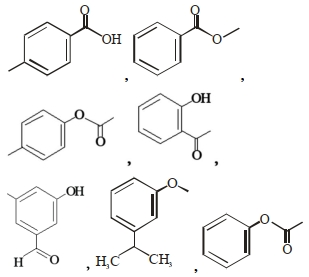
Number of compounds from the following which will not dissolve in cold $NaHCO _3$ and $NaOH$ solutions but will dissolve in hot $NaOH$ solution is $........$.
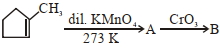
Identify products $A$ and $B$
What is compound $Z$ ?

$C{{H}_{3}}C{{H}_{2}}C{{H}_{2}}Br\xrightarrow{NaCN}$ $X\xrightarrow[heat]{{{H}_{3}}{{O}^{+}}}Y\xrightarrow[{{H}^{+}}]{C{{H}_{3}}C{{H}_{2}}OH}Z$

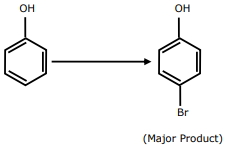
The given reaction can occur in the presence of:

$(1)$ Bromine water        $(2)$ $\mathrm{Br}_{2}$ in $\mathrm{CS}_{2}, 273 \mathrm{~K}$       $(3)$ $\mathrm{Br}_{2} / \mathrm{FeBr}_{3}$    $(4)$ $\mathrm{Br}_{2}$ in $\mathrm{CHCl}_{3}, 273 \,\mathrm{~K}$

Choose the correct answer from the options given below:
Which one of the following reactions does not occur?
The $IR$ stretchin frequencies of free $CO,$ and $CO$ in $[V(CO)_6]^-, [Cr(CO)_6]^-$ and $[Mn(CO)_6]^-$ are $2143\,cm^{-1} , 1860\,cm^{-1} , 2000 \,cm^{-1}$ and $2090 \,cm^{-1}$ , respectively. Then correct statement about metal  carbonyls is
$3{d^{10}}4{s^0}$ electronic configuration exhibits
Which of the following is not halide ore ?
Reaction of $R-2$ -butanol with $p-$ toluenesulphonyl chloride in pyridine followed  by reaction with $LiBr$ gives