MCQ
The correct stability order of carbocations is
  • A
    $\left(\mathrm{CH}_3\right)_3 \mathrm{C}^{+}>\mathrm{CH}_3-\stackrel{+}{\mathrm{C}} \mathrm{H}_2>\left(\mathrm{CH}_3\right)_2 \stackrel{+}{\mathrm{C}} \mathrm{H}>\stackrel{+}{\mathrm{C}} \mathrm{H}_3$
  • B
    $\stackrel{+}{\mathrm{C}} \mathrm{H}_3>\left(\mathrm{CH}_3\right)_2 \stackrel{+}{\mathrm{C}} \mathrm{H}>\mathrm{CH}_3-\stackrel{+}{\mathrm{C}} \mathrm{H}_2>\left(\mathrm{CH}_3\right)_3 \stackrel{+}{\mathrm{C}}$
  • $\left(\mathrm{CH}_3\right)_3 \stackrel{+}{\mathrm{C}}>\left(\mathrm{CH}_3\right)_2 \stackrel{+}{\mathrm{C}} \mathrm{H}>\mathrm{CH}_3-\stackrel{+}{\mathrm{C}} \mathrm{H}_2>\stackrel{+}{\mathrm{C}} \mathrm{H}_3$
  • D
    $\stackrel{+}{\mathrm{C}} \mathrm{H}_3>\mathrm{CH}_3-\stackrel{+}{\mathrm{C}} \mathrm{H}_2>\mathrm{CH}_3-\stackrel{+}{\mathrm{C}} \mathrm{H}>\left(\mathrm{CH}_3\right) \mathrm{C}^{+}\stackrel{+}{\mathrm{C}} \mathrm{H}_3$
Answer

Correct option: C.
$\left(\mathrm{CH}_3\right)_3 \stackrel{+}{\mathrm{C}}>\left(\mathrm{CH}_3\right)_2 \stackrel{+}{\mathrm{C}} \mathrm{H}>\mathrm{CH}_3-\stackrel{+}{\mathrm{C}} \mathrm{H}_2>\stackrel{+}{\mathrm{C}} \mathrm{H}_3$
c
More no. of hyperconjugable Hydrogens, more stable is the carbocations.

Need a full question paper?

Generate a complete, print-ready paper with questions like this in minutes — across 16+ boards, with answer keys.

Start Generating Free

Similar questions

The oxidation states of iron atoms in compounds $(A),$ $(B)$ and $(C),$ respectively, are $x,$ $y$ and $z.$ The sum of $x, y$ and $z$ is........

$(A)$ $\left. Na _{4}\left[ Fe ( CN )_{5} NOS \right)\right]$

$(B)$ $Na _{4}\left[ FeO _{4}\right]$

$(C)$ $\left[ Fe _{2}( CO )_{9}\right]$

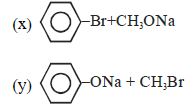
Which of the reactants given below is/are suitable for the preparation of Methoxybenzene ?
If $K_1$ and $K_2$ are respective equilibrium constants for the two reactions
$XeF_6 (g) + H_2O (g)  \rightleftharpoons  XeOF_4 (g) + 2HF (g)$
$XeO_4 (g) + XeF_6 (g) \rightleftharpoons XeOF_4 (g) + XeO_3F_2 (g)$
the equilibrium constant for the reaction $XeO_4 (g) + 2HF (g) \rightleftharpoons XeO_3F_2 (g) + H_2O (g)$ will be
The $pH$ at which $\mathrm{Mg}(\mathrm{OH})_2\left[\mathrm{~K}_{\mathrm{sp}}=1 \times 10^{-11}\right]$ begins to precipitate from a solution containing $0.10 \ \mathrm{M}$ $\mathrm{Mg}^{2+}$ ions is_____
The compound which does not show paramagnetism is
The wavelngth of radiation emitted when electron falls from $4^{th}$ Bohr orbit to $2^{nd}$ in $H$ atom is .............. $\mathrm{nm}$
$C_7H_9N$ has how many isomeric forms that contain a benzene ring
In acidic medium, $\ce{K_2Cr_2O_7}$ shows oxidising action as represented in the half reaction $\ce{Cr_2O_7^{2-} + XH^{+} + Ye^{-} \rightarrow 2 A + ZH_2O,  X , Y , Z}$ and $A$ are respectively are:
Benzene and naphthalene form an ideal solution at room temperature. For this process, the true statement$(s)$ is (are)

$(A)$ $\Delta G$ is positive $(B)$ $\Delta S _{\text {system }}$ is positive

$(C)$ $\Delta S _{\text {surroundings }}=0$ $(D)$ $\Delta H =0$

The correct order of increasing acid strenght of the compounds is

$(A)\, CH_3CO_2H$           $(B)\, MeOCH_2CO_2H$

$(C)\,CF_2CO_2H$           $(D)\,$ $Image$