MCQ
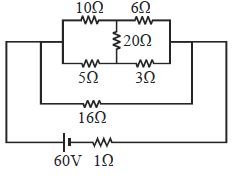
The current from the cell for the given circuit is ................ $\mathrm{A}$
  • $12$
  • B
    $6$
  • C
    $4$
  • D
    None

Answer

Correct option: A.
$12$
a
$\mathrm{R}_{\mathrm{eff}}=[(10+6)\|(5+3)\| 16\, \Omega] \,\mathrm{s} \,1\, \Omega$

$\mathrm{R}_{\mathrm{eff}}=5 \,\Omega$

Hence $\mathrm{I}=\frac{\mathrm{E}}{\mathrm{R}_{\mathrm{eff}}}=\frac{60}{5}=12 \mathrm{\,A}$

Need a full question paper?

Generate a complete, print-ready paper with questions like this in minutes — across 16+ boards, with answer keys.
Start Generating Free

Similar questions

The half-life of $215_{ At }$ is $100 \mu s$. The time taken for the radioactivity of a sample of $215_{ At }$ to decay to $1 / 16^{\text {th }}$ of its initial value is
Which of the following is a natural magnet?
Electromagnetic wave of intensity $1400\, W/m^2$ falls on metal surface on area $1.5\, m^2$ is completely absorbed by it. Find out force exerted by beam
When an electron in hydrogen atom is excited, from its $4^{\text {th }}$ to $5^{\text {th }}$ stationary orbit, the change in angular momentum of electron is (Planck's constant: $h =6.6 \times 10^{-34} J- s$ )
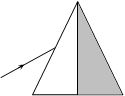
A light ray is incident upon a prism in minimum deviation position and suffers a deviation of $34^o $. If the shaded half of the prism is knocked off, the ray will
Lenz's law is consequence of the law of conservation of
Two electric charges $12\,\mu C$ and $ - 6\,\mu C$ are placed $20\, cm$ apart in air. There will be a point $P$ on the line joining these charges and outside the region between them, at which the electric potential is zero. The distance of $P$ from $ - 6\,\mu C$ charge is.......$m$
In a Young’s double slit experiment, the slit separation is $0.2\, cm$, the distance between the screen and slit is $1\,m$. Wavelength of the light used is $5000 Å.$ The distance between two consecutive dark fringes (in $mm$) is
A dip needle lies initially in the magnetic meridian when it shows an angle of dip q at a place. The dip circle is rotated through an angle x in the horizontal plane and then it shows an angle of dip $\theta^{\prime}$. Then $\frac{\tan \theta^{\prime}}{\tan \theta}$ is
Unpolarized light of intensity $32Wm^{-2}$ passes through three polarizers such that transmission axes of the first and second polarizer makes and angle $30^\circ$ with each other and the transmission axis of the last polarizer is crossed with that of the first. The intensity of final emerging light will be