Question
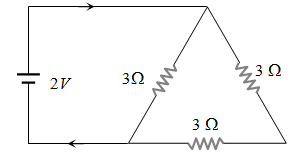
The current in the following circuit is
|
(a) |
(b) |
(c) |
(d) 1A |
The current in the following circuit is
|
(a) |
(b) |
(c) |
(d) 1A |
(d) 1A
Generate a complete, print-ready paper with questions like this in minutes — across 16+ boards, with answer keys.
X-rays cannot be deflected by means of an ordinary grating due to
|
(a) Large wavelength |
(b) High speed |
(c) Short wavelength |
(d) None of these |
The capacitance of a metallic sphere will be 1μF, if its radius is nearly
|
(a) 9 km |
(b) 10 m |
(c) 1.11 m |
(d) 1.11 cm |
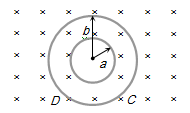
Plane figures made of thin wires of resistance R = 50 milli ohm/metre are located in a uniform magnetic field perpendicular into the plane of the figures and which decrease at the rate dB/dt = 0.1 m T/s. Then currents in the inner and outer boundary are. (The inner radius a = 10 cm and outer radius b = 20 cm)
|
(a) 10– 4 A (Clockwise), 2 × 10– 4 A (Clockwise) |
|
(b) 10– 4 A (Anticlockwise), 2 × 10– 4 A (Clockwise) |
|
(c) 2 × 10– 4 A (clockwise), 10– 4 A (Anticlockwise) |
|
(d) 2 × 10– 4 A (Anticlockwise), 10– 4 A (Anticlockwise) |
When  is bombarded with one neutron, the fission occurs and the products are three neutrons,
  and
and
(a) 
|
(b) 
|
(c) 
|
(d) 
|
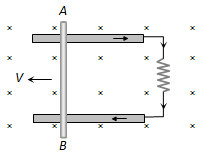
Consider the situation shown in the figure. The wire AB is sliding on the fixed rails with a constant velocity. If the wire AB is replaced by semicircular wire, the magnitude of the induced current will
| (a) Increase |
|
(b) Remain the same |
|
(c) Decrease |
|
(d) Increase or decrease depending on whether the semicircle bulges towards the resistance or away from it |
A photo cell is receiving light from a source placed at a distance of 1 m. If the same source is to be placed at a distance of 2 m, then the ejected electron
|
(a) Moves with one-fourth energy as that of the initial energy |
|
(b) Moves with one-fourth of momentum as that of the initial momentum |
|
(c) Will be half in number |
|
(d) Will be one-fourth in number |


