MCQ
The current through a wire depends on time as $i = (2+3t)\, mA$. The charge crossing through a section of the wire in $1\, min$ is .............. $\mathrm{C}$
  • A
    $40.20$
  • B
    $24.55$
  • C
    $12.75$
  • $5.52$

Answer

Correct option: D.
$5.52$
d
$i=2+3 t$

$\int \mathrm{d} q=\int i d t$

$\mathrm{q}=\int_{0}^{60} 2+3 \mathrm{t} \mathrm{dt}\left(\times 10^{-3}\right)$

$\mathrm{q}=\left[2 \mathrm{t}+\frac{3 \mathrm{t}^{2}}{2}\right]_{0}^{60} \times 10^{-3}$

$=[120+5400] \times 10^{-3}=5.52$ $\mathrm{coulamb}.$

Need a full question paper?

Generate a complete, print-ready paper with questions like this in minutes — across 16+ boards, with answer keys.
Start Generating Free

Similar questions

A resistance wire connected in the left gap of a meter bridge balances a $10\, \Omega$ resistance in the right gap at a point which divides the bridge wire in the ratio $3: 2 .$ If the length of the resistance wire is $1.5 m ,$ then the length of $1\, \Omega$ of the resistance wire is $....... \times 10^{-2}\;m$
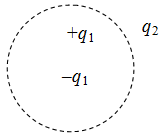
Consider the charge configuration and spherical Gaussian surface as shown in the figure. When calculating the flux of the electric field over the spherical surface the electric field will be due to
The sun makes $0.5^o$ angle on earth surface. Its image is made by convex lens of $50 cm$ focal length. The diameter of the image will be......$mm$
Three concentric conducting spherical shells have radius $ r, 2r$ and $3r$ and $Q_1, Q_2$ and $Q_3$ are final charges respectively. Innermost and outermost shells are already earthed as shown in figure. Choose the wrong statement.
Two very long, straight and parallel wires carry steady currents $I$ and $I$ respectively. The distance between the wires is $d$. At a certain instant of time, a point charge $q$ is at a point equidistant from the two wires in the plane of the wires. Its instantaneous velocity $v$ is perpendicular to this plane. The magnitude of the force due to the magnetic field acting on the charge at this instant is
A thin rectangular magnet suspended freely has a period of oscillation equal to $T.$ Now it is broken into two equal halves (each having half of the original length) and one piece is made to oscillate freely in the same field. If its period of oscillation is $T',$ the ratio $T'/T$ is :-
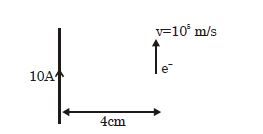
An $e^-$ is moving parallel to a long current carrying wire as shown. Force on electron is
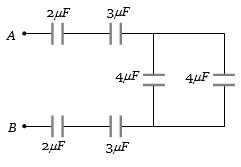
The effective capacity between $A$ and $B$ in the figure given is
Two identical charged spherical drops each of capacitance C merge to form a single drop. The resultant capacitance is
Nearly $10 \%$ of the power of a $110\,W$ light bulb is converted to visible radiation. The change in average intensities of visible radiation, at a distance of $1\, m$ from the bulb to a distance of $5\,m$ is $a \times 10^{-2}\,W / m ^{2}$. The value of ' $a$ ' will be.