Question
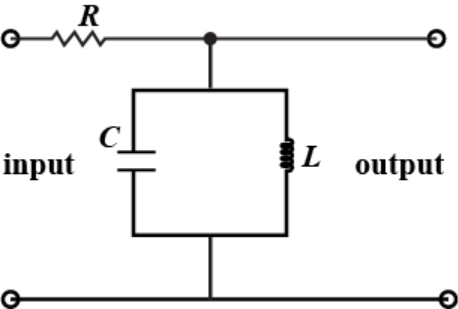
The circuit shown in Fig. acts as a.
Image

Answer

  1. tuned filter
Explanation:
The circuit shown in figure has capacitor and inductor in parallel so their will be current flowing continuously with energy being transformed into electrical in capacitor and magnetic in inductor, hence it is a tuned filter.

Need a full question paper?

Generate a complete, print-ready paper with questions like this in minutes — across 16+ boards, with answer keys.
Start Generating Free

Similar questions

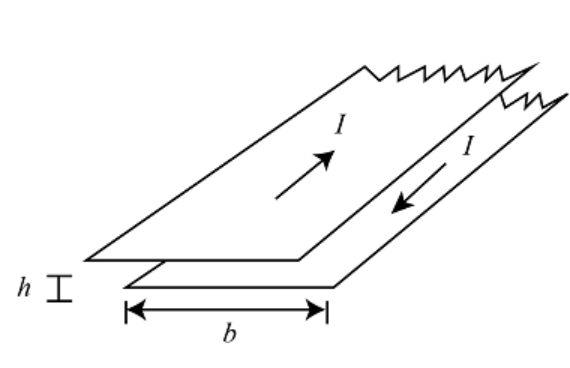
Calculate the inductance of a unit length of a double tape line as shown in figure. The tapes are separated by a distance h which is considerably less than their width b.
Image
The magnetic susceptibility is
A capacitor is connected to an A.C. circuit, then the phase difference between current and the voltage is:
The rate of change of magnetic flux density through a circular coil of area $10m$ and number of turns $100$ is $10^3\  Wb/ m^2/ s.$ The value of induced emf will be.
The kinetic energy of an electron is $5\ eV.$ Calculate the de$-$Broglie wavelength associated with it $(h = 6.6 \times 10^{–34} Js, m_e = 9.1 \times 10^{–31} \ kg)$
Wavefront means(a) All particles in it have same phase(b) All particles have opposite phase of vibrations(c) Few particles are in same phase, rest are in opposite phase(c) Few particles are in same phase, rest are in opposite phase(d) None of these


Due to a dipole, the field at a distance r on its axial line and the field at a distance r on its perpendicular bise- ctor (non-axis line) will be produced:
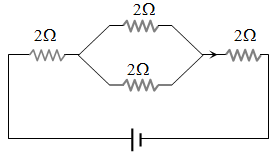
The equivalent resistance of the circuit shown in the figure is
As the temperature of a conductor increases, its resistivity and conductivity change. The ratio of resistivity to conductivity:
  1. Increases.
  2. Decreases.
  3. Remains constant.
  4. May increase or decrease, depending on the actual temperature.
The magnetic flux linked with a circuit of resistance 100 ohm increases from 10 to 60 webers. The amount of induced charge that flows in the circuit is (in coulomb)(a) 0.5(b) 5(c) 50       (d) 100