MCQ
The difference between spin only magnetic moment values of $\left[ Co \left( H _{2} O \right)_{6}\right] Cl _{2}$ and $\left[ Cr \left( H _{2} O \right)_{6}\right] Cl _{3}$ is $....$
  • A
    $1$
  • B
    $2$
  • $0$
  • D
    $3$

Answer

Correct option: C.
$0$
c
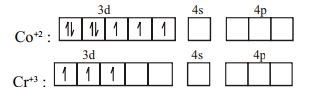
number of unpaired $e^{-}=3$

$\mu=\sqrt{15}\,BM$

${\left[ Cr \left( H _{2} O \right)_{6}\right]^{3+}}$

number of unpaired $e^{-}=3$

$\mu=\sqrt{15}\,BM$

Difference in spin only magnetic moment $=0$
Need a full question paper?

Generate a complete, print-ready paper with questions like this in minutes — across 16+ boards, with answer keys.

Start Generating Free

Similar questions

The number of possible isomers of an octahedral complex $[Co(C_2O_4)_2\,(NH_3)_2 ]^-$ is
Product $(A)$ is
Which of the following has the highest molar conductivity solution ?
Acetonitrile is:
$\begin{array}{*{20}{c}}
{O\,\,\,\,\,\,\,\,\,\,\,\,\,\,\,\,\,\,O}\\
{||\,\,\,\,\,\,\,\,\,\,\,\,\,\,\,\,\,\,\,\,||}\\
{C{H_3} - C - O - C - C{H_3}}
\end{array}$ (image) $(A)$

Product $(A)$ is

When a rod of metal $A$ is dipped in an aqueous solution of metal $B$ (concentration of ${B^{2 + }}$ ion being $1\,M$ ) at ${25\,^o}C$, the standard electrode potentials are ${A^{2 + }}/A$ $ = -0.76 $ volts, ${B^{2 + }}$ $/B = + 0.34$ volts
Which one of the following shows maximum paramagnetic character
For each of the following pairs of $E_2$ reaction, select the one that occurs with  the greater rate constant.

$(1)$ $C{H_3}C{H_2}C{H_2}Cl + $ $\begin{array}{*{20}{c}}
  {\,\begin{array}{*{20}{c}}
  {\,\,\,\,\,\,\,\,\,\,C{H_3}} \\ 
  {\,\,\,|} 
\end{array}} \\ 
  {C{H_3} - C - {O^ - }} \\ 
  {\,\,\,|} \\ 
  {\,\,\,\,\,\,\,\,\,\,C{H_3}} 
\end{array}$                      $(2)$  $C{H_3}C{H_2}C{H_2}I + $$\begin{array}{*{20}{c}}
  {\,\begin{array}{*{20}{c}}
  {\,\,\,\,\,\,\,\,\,\,C{H_3}} \\ 
  {\,\,\,|} 
\end{array}} \\ 
  {C{H_3} - C - {O^ - }} \\ 
  {\,\,\,|} \\ 
  {\,\,\,\,\,\,\,\,\,\,C{H_3}} 
\end{array}$

$(3)$  $\begin{array}{*{20}{c}}
  {{H_3}C - CH - C{H_3}} \\ 
  {|\,\,\,\,} \\ 
  {Br\,\,\,} 
\end{array}$  $+CH_3O^-$                      $(4)$  $\begin{array}{*{20}{c}}
  {{H_3}C - CH - C{H_3}} \\ 
  {|\,\,\,\,} \\ 
  {Br\,\,\,} 
\end{array}$ $+CH_3S^-$

The catalytic activity of the transition metals and their compounds is ascribed to their
The emf of a Daniel cell at $ 298\,K$ is ${E_1}$ $Zn|\mathop {ZnS{O_4}}\limits_{(0.01\,M)} ||\mathop {CuS{O_4}}\limits_{(1.0\,M)} |Cu$ when the concentration of $ZnS{O_4}$ is $1.0\,M $ and that of $CuS{O_4}$ is $0.01\,M$, the emf changed to ${E_2}$. What is the relationship between ${E_1}$ and ${E_2}$