MCQ
The dimension of quantity $\frac{L}{RCV}$ is
  • A
    $[A]$
  • B
    $[{A^2}]$
  • $[{A^{ - 1}}]$
  • D
    None of these

Answer

Correct option: C.
$[{A^{ - 1}}]$
c
(c) $\frac{L}{{RCV}} = \left[ {\frac{L}{R}} \right]\,\,\frac{1}{{CV}} = \frac{T}{Q} = [{A^{ - 1}}]$

Need a full question paper?

Generate a complete, print-ready paper with questions like this in minutes — across 16+ boards, with answer keys.
Start Generating Free

Similar questions

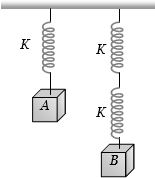
The springs shown are identical. When $A = 4kg$, the elongation of spring is $1\, cm$. If $B = 6\,kg$, the elongation produced by it is  ..... $ cm$
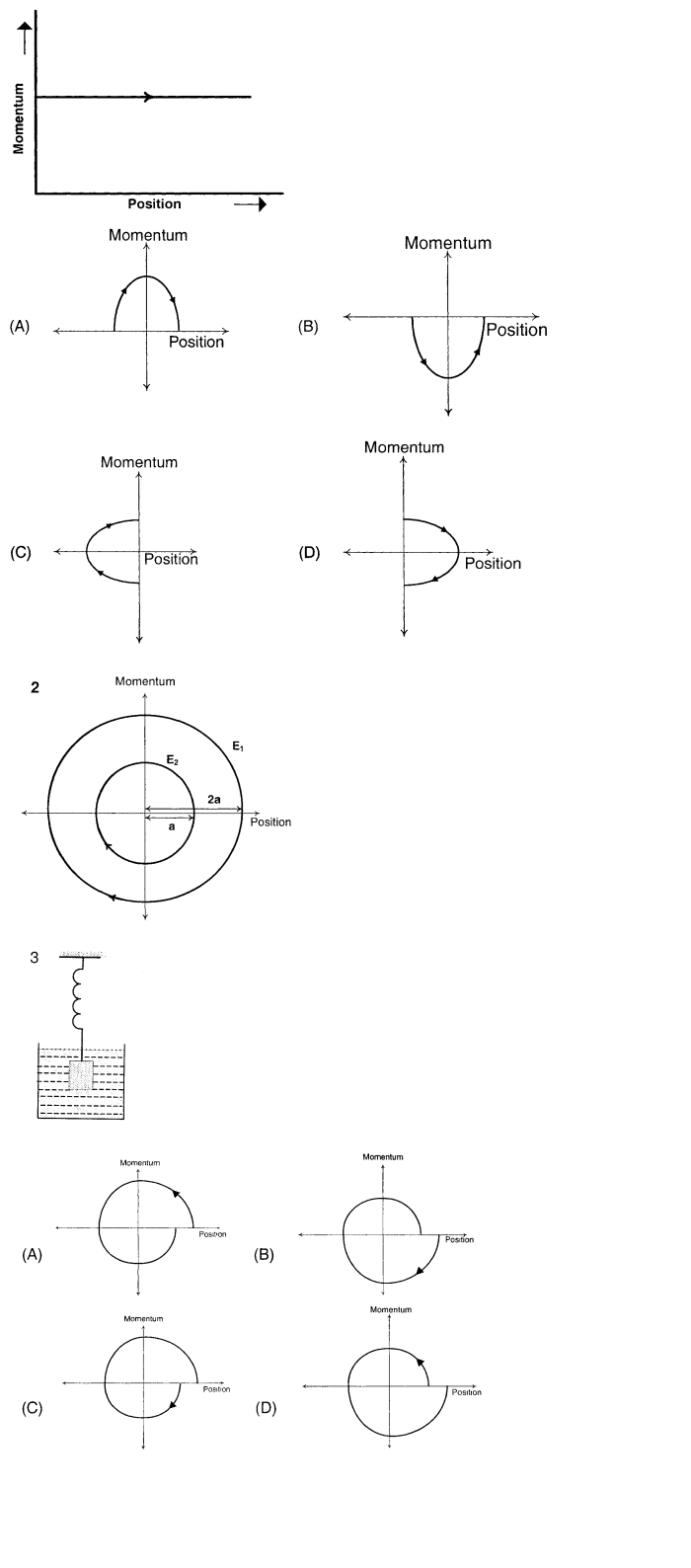
Phase space diagrams are useful tools in analyzing all kinds of dynamical problems. They are especially useful in studying the changes in motion as initial position and momentum are changed. Here we consider some simple dynamical systems in one-dimension. For such systems, phase space is a plane in which position is plotted along horizontal axis and momentum is plotted along vertical axis. The phase space diagram is $x(t)$ vs. $p(t)$ curve in this plane. The arrow on the curve indicates the time flow. For example, the phase space diagram for a particle moving with constant velocity is a straight line as shown in the figure. We use the sign convention in which position or momentum upwards (or to right) is positive and downwards (or to left) is negative. $Image$

$1.$ The phase space diagram for a ball thrown vertically up from ground is

mcq $Image$

$2.$ The phase space diagram for simple harmonic motion is a circle centered at the origin. In the figure, the two circles represent the same oscillator but for different initial conditions, and $E_1$ and $E_2$ are the total mechanical energies respectively. Then $Image$

$(A)$ $ E_1=\sqrt{2} E_2$ $(B)$ $ E_1=2 E_2$

$(C)$ $ E_1=4 E_2$ $(D)$ $ E_1=16 E_2$

$3.$ Consider the spring-mass system, with the mass submerged in water, as shown in the figure. The phase space diagram for one cycle of this system is $Image$

mcq $Image$

Give the answer question $1,2$ and $3.$
A train is moving along a straight line with a constant acceleration ' $a$ '. A boy standing in the train throws a ball forward with a speed of $10 \ m / s$, at an angle of $60^{\circ}$ to the horizontal. The boy has to move forward by $1.15 \ m$ inside the train to catch the ball back at the initial height. The acceleration of the train, in $m / s ^2$, is
The ratio of powers of two motors is $\frac{3 \sqrt{x}}{\sqrt{x}+1}$, that are capable of raising $300\,kg$ water in $5$ minutes and $50\,kg$ water in $2$ minutes respectively from a well of $100\,m$ deep. The value of $x$ will be
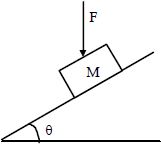
A block of mass $M$ is sliding down the plane. Coefficient of static friction is $\mu _s$ and kinetic friction is $\mu _k.$ Then friction force acting on the block is :-
If the two ends of a p-n junction are joined by a wire:
  1. There will not be a steady current in the circuit.
  2. There will be a steady current from the n-side to the p-side.
  3. There 'will a steady current from the p-side. to the n-side.
  4. There may or may not be a current depending upon the resistance of the connecting wire.
A neutron moving with velocity $u$ collides elastically with an atom of mass number $A$ . If the collision is head-on and the initial kinetic energy of neutron is $E$ , then the final kinetic energy of the neutron after collision is
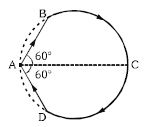
Consider a circle of radius $42\  cm$. An insect crawls with uniform speed of $1.3\  cm/s$ along the chord $AB$ then along the circular arc $BCD$ to reach point $D$ and then following cord $DA$ to reach finally $A$. Time spend by the insect to crawl from $A$ to $A$ is closest to    ......... $\sec$
Given below are two statements : one is labelled as Assertion $A$ and the other is labelled as Reason $R.$

Assertion $A :$ Moment of inertia of a circular disc of mass $'M'$ and radius $'R'$ about $X, Y$ axes (passing through its plane) and $Z-$axis which is perpendicular to its plane were found to be $I_{x}, I_{y}$ and ${I}_{z}$ respectively. The respective radii of gyration about all the three axes will be the same.

Reason $R$ : A rigid body making rotational motion has fixed mass and shape.

In the light of the above statements, choose the most appropriate answer from the options given below :
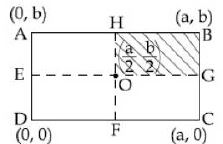
A uniform rectangular thin sheet $ABCD$ of mass $M$ has length $a$ and breadth $b$, as shown in the figure. If the shaded portion $HBGO$ is cut off, the coordinates of the centre of mass of the remaining portion will be