MCQ
Given below are two statements : one is labelled as Assertion $A$ and the other is labelled as Reason $R.$

Assertion $A :$ Moment of inertia of a circular disc of mass $'M'$ and radius $'R'$ about $X, Y$ axes (passing through its plane) and $Z-$axis which is perpendicular to its plane were found to be $I_{x}, I_{y}$ and ${I}_{z}$ respectively. The respective radii of gyration about all the three axes will be the same.

Reason $R$ : A rigid body making rotational motion has fixed mass and shape.

In the light of the above statements, choose the most appropriate answer from the options given below :

  • A
    Both $A$ and $R$ are correct but $R$ is NOT the correct explanation of $A$.
  • $A$ is not correct but $R$ is correct.
  • C
    $A$ is correct but $R$ is not correct.
  • D
    Both $A$ and $R$ are correct and $R$ is the correct explanation of $A$.
Answer

Correct option: B.
$A$ is not correct but $R$ is correct.
b
$I_{z}=I_{x}+I_{y}$ (using perpendicular axls theorem)

$l = mk ^{2}$ (K: radius of gyratlon)

so $m K_{z}^{2}=m K_{x}^{2}+m K_{y}^{2}$

$K_{z}^{2}=K_{x}^{2}+K_{y}^{2}$

so radius of gyration about axes $x, y$ and $z$ won't be same hense asseration $A$ is not correct reason $R$ is correct statement (property of a rlgid body)

Need a full question paper?

Generate a complete, print-ready paper with questions like this in minutes — across 16+ boards, with answer keys.

Start Generating Free

Similar questions

Vapour is injected at a uniform rate in a closed veseel which was initially evacuated. The pressure in the vessel:
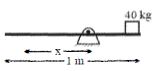
A mass $M= 40\  kg$ is fixed at the very edge of a long plank of mass $80\  kg$ and length $1\ m$ which is pivoted such that it is in equilibrium. How far (approx.) from the pivot should a mass of $100\  kg$ be attached so that the plank starts rotating with an angular acceleration of $1\ rad/s^2$?
From a stationary tank of mass $125000$ pound a small shell of mass $25$ pound is fired with a muzzle velocity of $1000\, ft/sec$. The tank recoils with a velocity of ............ $\mathrm{ft/sec}$
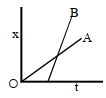
The position-time graphs for two students $A$ and $B$ returning from the school to their homes are shown in figure

$(A)$ $A$ lives closer to the school

$(B)$ $B$ lives closer to the school

$(C)$ $A$ takes lesser time to reach home

$(D)$ $A$ travels faster than $B$

$(E)$ $B$ travels faster than $A$

Choose the correct answer from the options given below :

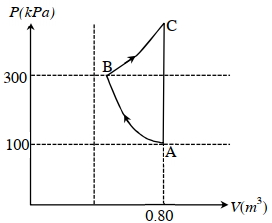
In the given $P$-V diagram, a monoatomic gas $\left(\gamma=\frac{5}{3}\right)$ is first compressed adiabatically from state $A$ to state $B$. Then it expands isothermally from state $B$ to state $C$. [Given: $\left(\frac{1}{3}\right)^{0.6} \simeq 0.5, \ln 2 \simeq 0.7$ ].

Which of the following statement($s$) is(are) correct?

$(A)$ The magnitude of the total work done in the process $A \rightarrow B \rightarrow C$ is $144 kJ$.

$(B)$ The magnitude of the work done in the process $B \rightarrow C$ is $84 kJ$.

$(C)$ The magnitude of the work done in the process $A \rightarrow B$ is $60 kJ$.

$(D)$ The magnitude of the work done in the process $C \rightarrow A$ is zero.

Which of the following systems may be adequately described by classical physics?
  1. Motion of a cricket ball.
  2. Motion of a dust particle.
  3. A hydrogen atom.
  4. A neutron changing to a proton.
If two satellites of different masses are revolving in the same orbit, they have same:
A carnot engine is made to work between $200\,^oC$ and $0\,^oC$ first and then between $0\,^oC$ and $-200\,^oC$. The ratio of efficiencies $\left( {\frac{{{\eta _2}}}{{{\eta _1}}}} \right)$ of the engine in two cases is
The bulk modulus of a liquid is $3 \times 10^{10}\, Nm ^{-2}$. The pressure required to reduce the volume of liquid by $2 \%$ is  ........ $\times 10^{8}\; Nm ^{-2}$
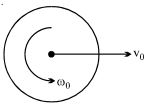
$A$ uniform sphere of radius $R$ is placed on $a$ rough horizontal surface and given a linear velocity $v_0$ angular velocity $\omega_0$ as shown. The sphere comes to rest after moving some distance to the right. It follows that: