MCQ
The dimensions of pressure is equal to
  • A
    Force per unit volume
  • Energy per unit volume
  • C
    Force
  • D
    Energy

Answer

Correct option: B.
Energy per unit volume
(b) $\frac{\text { Energy }}{\text { Volume }}=\frac{M L^2 T^{-2}}{L^3}=\left[M L^{-1} T^{-2}\right]=$ Pressure

Need a full question paper?

Generate a complete, print-ready paper with questions like this in minutes — across 16+ boards, with answer keys.

Start Generating Free

Similar questions

What is the relation between displacement, time and acceleration in case of a body having uniform acceleration
Deviation of $5^{\circ}$ is observed from a prism whose angle is small and whose refractive index is $1.5.$ The angle of prism is
According to Newton, the viscous force acting between liquid layers of area $A$ and velocity gradient $\Delta v / \Delta z$ is given by $F=-\eta A \frac{\Delta v}{\Delta z}$ where $\eta$ is constant called coefficient of viscosity. The dimension of $\eta$ are
Two masses of $1 \mathrm{~kg}$ and $16 \mathrm{~kg}$ are moving with equal K.E. The ratio of magnitude of the linear momentum is
Two polaroids are placed in the path of unpolarized beam of intensity $I_0$ such that no light is emitted from the second polaroid. If a third polaroid whose polarization axis makes an angle $\theta$ with the polarization axis of first polaroid, is placed between these polaroids then the intensity of light emerging from the last polaroid will be
Referring to the above two questions, the acceleration due to gravity is given by
If in nature there may not be an element for which the principal quantum number $n>4$, then the total possible number of elements will be
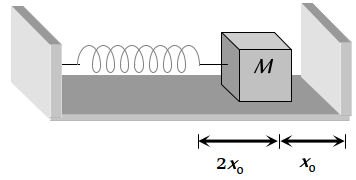
One end of a spring of force constant $k$ is fixed to a vertical wall and the other to a block of mass $m$ resting on a smooth horizontal surface. There is another wall at a distance $x_0$ from the black. The spring is then compressed by $2 x_0$ and released. The time taken to strike the wall is

Image

What is the value of linear velocity, if $\vec{\omega}=3 \hat{i}-4 \hat{j}+\hat{k}$ and $\vec{r}=5 \hat{i}-6 \hat{j}+6 \hat{k}$
In the above problem, the luminous flux emitted by sun will be