MCQ
The diode shown in the circuit is a silicon diode. The potential difference between the points $A$ and $B$ will be
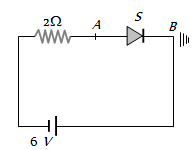
  • $6 V$
  • B
    $0.6 V$
  • C
    $0.7 V$
  • D
    $0 V$

Answer

Correct option: A.
$6 V$
$6 V$

Need a full question paper?

Generate a complete, print-ready paper with questions like this in minutes — across 16+ boards, with answer keys.
Start Generating Free

Similar questions

A 25 watt, 220 volt bulb and a 100 watt, 220 volt bulb are connected in parallel across a 220 volt line. Which bulb will glow more brightly (a) 25 watt bulb(b) 100 watt bulb(c) Both will have same brightness(d) First 25 watt then 100 watt
   
   
Sun radiates continuously and maintains its brightness because(a) Helium is converted into iron in its core(b) Of fusion of hydrogen nuclei into helium(c) Fusion of helium in hydrogen(d) Burning of carbon, in its core


A vertical wire carries a current in upward direction. An electron beam sent horizontally towards the wire will be deflected:
  1. Towards right.
  2. Towards left.
  3. Upwards.
  4. Downwards.
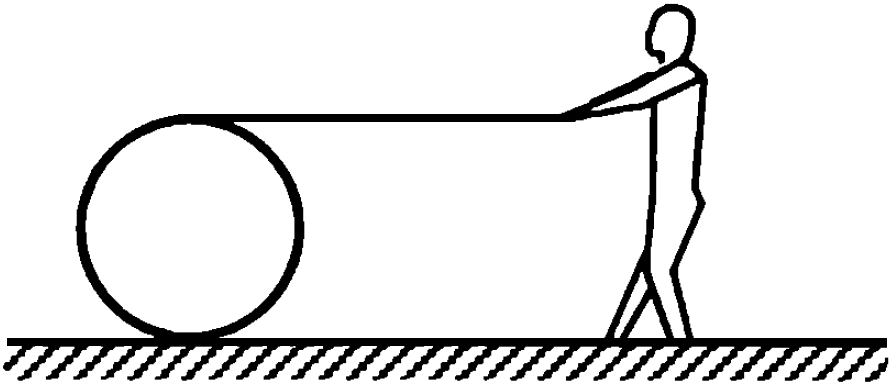
A string of negligible thickness is wrapped several times around a cylinder kept on a rough horizontal surface. A man standing at a distance $1$ from the cylinder holds one end of the string and pulls the cylinder towards him. There is no slipping anywhere. The length of the string passed through the hand of the man while the cylinder reaches his hands is:
The lowest frequency of light that will cause the emission of photoelectrons from the surface of a metal $($for which work function is $1.65 \ eV)$ will be
The danger signals installed at the top of tall buildings are red in colour. These can be easily seen from a distance because among all other colours, the red light:
A triode whose mutual conductance is 2.5 m A/volt and anode resistance is 20 kilo ohm, is used as an amplifier whose amplification is 10. The resistance connected in plate circuit will be(a) 1 kW  (b) 5 kW(c) 10 kW(d) 20 kW
       
The phenomenon by which light travels in an optical fibres is(a) Reflection(b) Refraction(c) Total internal reflection(d) Transmission
   
   
A copper ring is held horizontally and a bar magnet is dropped through the ring with its length along the axis of the ring. The acceleration of the falling magnet while it is passing through the ring is(a) Equal to that due to gravity (b) Less than that due to gravity(c) More than that due to gravity(d) Depends on the diameter of the ring and the length of the magnet


Let $\triangle\text{W}_\text{a}$ and $\triangle\text{W}_\text{b}$ be the work done by the systems A and B, respectively, in the previous question.
  1. $\triangle\text{W}_\text{a}>​​\triangle\text{W}_\text{b}$
  2. $\triangle\text{W}_\text{a}=​​\triangle\text{W}_\text{b}$
  3. $\triangle\text{W}_\text{a}<​​\triangle\text{W}_\text{b}$
  4. The relation between $\triangle\text{W}_\text{a}$ and $\triangle\text{W}_\text{b}$ cannot be deduced.