MCQ
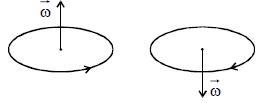
The direction of the angular velocity vector along
  • A
    the tangent to the circular path
  • B
    the inward radius
  • C
    the outward radius
  • the axis of rotation

Answer

Correct option: D.
the axis of rotation
d
Angular velocity is a vector whose direction is perpendicular to the plane of circular path or axis of rotation. Its direction has been shown in the figure

Need a full question paper?

Generate a complete, print-ready paper with questions like this in minutes — across 16+ boards, with answer keys.
Start Generating Free

Similar questions

A cube of edge length $10 \,cm$ is just balanced at the interface of two liquids $A$ and $B$ as shown in figure. If $A$ and $B$ has specific gravity $0.6$ and $0.4$ respectively, then mass of cube is ................ $g$
Sound waves in air are
Water falls from a height of $60\, m$ at the rate of $15 kg/s$ to operate a turbine. The losses due to frictional forces are $10\%$ of energy. How much power is generated by the turbine ............. $\mathrm{kW}$ ? $\, (g = 10 \,m/s^2)$
The total kinetic energy of translatory motion of all the molecules of $5$ litres of nitrogen exerting a pressure $P$ is $3000 \,\,J$.
A tank with a square base of area $2.0 m^2$ is divided into two compartments by a vertical partition in the middle. There is a small hinged door of face area $20 cm^2$ at the bottom of the partition. Water is filled in one compartment and acid, of relative density 1.7 , in the other, both to a height of 4 m . If $g =10 ms^{-2}$ the force necessary to keep the door closed is:
A mass of $0.2\,kg$ is attached to the lower end of a massless spring of force-constant $200\, N/m,$ the upper end of which is fixed to a rigid support. Which of the following statements is/are true ?
A particle is moving along a straight line with constant acceleration. At the end of tenth  second its velocity becomes $20\, m/s$ and in tenth second it travels a distance of $10\, m$.  Then the acceleration of the particle will be........$m/s^2$
$m x^{2}-b x+k=0$

Find time after which to the energy will become half of initial maximum value in damped force oscillation.

A vibratory motion is represented by $x = 2\,A\,\cos \,\omega t + A\,\cos \,\left( {\omega t + \frac{\pi }{2}} \right) + A\,\cos \,\left( {\omega t + \pi } \right) + \frac{A}{2}\,\cos \,\left( {\omega t + \frac{{3\pi }}{2}} \right)$ The resultant amplitude of motion is
Equation of a progressive wave is given by $y = 0.2\cos \pi \left( {0.04t + 0.02x - \frac{\pi }{6}} \right)$The distance is expressed in $cm$ and time in second. What will be the minimum distance between two particles having the phase difference of $\pi /2$ ...... $cm$