MCQ
The displacement current flows in the dielectric of a capacitor when the potential difference across its plates.
- Abecomes zero
- Bhas assumed a constant value
- Cis increasing with time
- Dis decreasing with time
Explanation:
According to Maxwell's hypothesis, a displacement current will flow through a capacitor when the potential difference across its plates is varying. Thus a varying electric field will exist between the plates and this displacement current is same in magnitude to the current flowing in outer circuit. When a D.C voltage applied across its plates, constant voltage appears across its plates and so there will be no displacement current flowing through the capacitor. Thus the displacement current will flow when the potential is increasing with time.
Generate a complete, print-ready paper with questions like this in minutes — across 16+ boards, with answer keys.
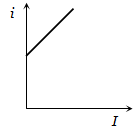
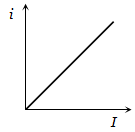
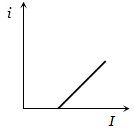
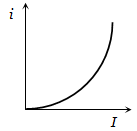
The graph between intensity of light falling on a metallic plate (I) with the current (i) generated is
|
(a)
|
(b)
|
(c)
|
(d)
|
A ray passes through a prism of angle 60° in minimum deviation position and suffers a deviation of 30°. What is the angle of incidence on the prism
|
(a) 30° |
(b) 45° |
(c) 60° |
(d) 90° |
Two bulbs X and Y having same voltage rating and of power 40 watt and 60 watt respectively are connected in series across a potential difference of 300 volt, then
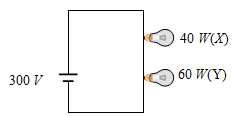
|
(a) X will glow brighter |
(b) Resistance of Y is greater than X |
|
(c) Heat produced in Y will be greater than X |
(d) Voltage drop in X will be greater than Y |
The condition for a uniform spherical mass m of radius r to be a black hole is [G = gravitational constant and g = acceleration due to gravity]
|
(a) |
(b) |
(c) |
(d) |
When the temperature of silicon sample is increased from 27℃ to 100℃, the conductivity of silicon will be
|
(a) Increased |
(b) Decreased |
(c) Remain same |
(d) Zero |
Assertion : Basic difference between an electric line and magnetic line of force is that former is discontinuous and the latter is continuous or endless.
Reason : No electric lines of forces exist inside a charged body but magnetic lines do exist inside a magnet.
|
(a) If both assertion and reason are true and the reason is the correct explanation of the assertion. |
|
(b) If both assertion and reason are true but reason is not the correct explanation of the assertion. |
|
(c) If assertion is true but reason is false. |
|
(d) If the assertion and reason both are false. |
An electric line of force in the xy plane is given by equation  . A particle with unit positive charge, initially at rest at the point x = 1, y = 0 in the xy plane
|
(a) Not move at all |
|
(b) Will move along straight line |
|
(c) Will move along the circular line of force |
|
(d) Information is insufficient to draw any conclusion |